Join Online Spiritual Academy

Atman On Substack

ATMAN NITYANANDA - SUBSTACK
Walk the Path of Truth & Freedom

Help Atman's Mission to Flourish

Help Atman's Mission to Flourish
Greatfull for Your Support !
Showing posts with label RAMANA MAHARSHI. Show all posts

Tuesday, March 11, 2025

OM! Devotion and Self-enquiry are the same by Ramana Maharshi

DEVOTION & SELF- ENQUIRY ARE THE SAME

Ramana: Jnana Marga (advaita self-enquiry) and Bhakti Marga (devotion to God with form) are one and the same.

Self-surrender leads to realisation just as enquiry does. Complete self-surrender means that you have no further thought of 'I'. Then all your predispositions (samskaras) are washed off and you are free. You should not continue as a separate entity at the end of either course.

Talks with Sri Ramana Maharshi

The 'secret' to a plentiful life, a life of harmony, happiness and contentment is to have a sattvic mind free from desires and ego and to live in every moment in conscious contact with our true Self (Consciousness).

🌺 Peace, Love, Harmony

Saturday, December 14, 2024

I'm! THE WORLD IS REAL OR ILLUSORY? ~ Ramana Maharshi


THE WORLD IS REAL OR ILLUSORY ?

Question: "Brahman is real. The world is illusion" is the stock phrase of Sri Sankaracharya. Yet others say, "The world is reality." Which is true?
 
Sri Ramana Maharshi: Both statements are true. They refer to different stags of development and are spoken from different points of view. The aspirant starts with the definition, that which is real exists always. Then he eliminates the world as unreal because it is changing. The seeker ultimately reaches the Self and there finds unity as the prevailing note. Then, that which was originally rejected as being unreal is found to be a part of the unity. Being absorbed in the reality, the world also is real. There is only being in Self-realisation, and nothing but being.


Question: Sri Bhagavan (Ramana Maharshi) often says that Maya (illusion) and reality are the same. How can that be?
 
Sri Ramana Maharshi: Sankaracharya was criticised for his views on Maya without being understood. He said that: 1. Brahman is real, 2. The universe is unreal, and 3. The universe is Brahman.
He did not stop at the second, because the third explains the other two. It signifies that the universe is real if perceived as the Self, and unreal if perceived apart from the Self. Hence Maya and reality are one and the same.


Question: So the world is not really illusory?
 
Sri Ramana Maharshi: At the level of the spiritual seeker you have got to say that the world is an illusion. There is no other way. When a man forgets that he is a Brahman, who is real, permanent and omnipresent, and deludes himself into thinking that he is a body in the universe which is filled with bodies that are transitory, and labours under that delusion, you have got to remind him that the world is unreal and a delusion. Why? Because his vision which has forgotten its own Self is dwelling in the external, material universe. It will not turn inwards into introspection unless you impress on him that all this external material universe is unreal. When once he realises his own Self he will know that there is nothing other than his own Self and he will come to look upon the whole universe as Brahman.
There is no universe without the Self. So ling as a man does not see the Self which is the origin of all, but looks only at the external world as real and permanent, you have to tell him that all this external universe is an illusion. You cannot help it. Take a paper. We see only the script, and nobody notices the paper on which the script is written. The paper is there whether the script on it is there or not. To those who look upon the script as real, you have to say that it is unreal, an illusion, since it rests upon the paper. The wise man looks upon both the paper and script as one. So also with Brahman and the universe.

Question: So the world is real when it is experienced as the Self and unreal when it is seen as separate names and forms?

Sri Ramana Maharshi: Just as fire is obscured by smoke, the shining light of consciousness is obscured by the assemblage of names and forms, the world. When by compassionate divine grace the mind becomes clear, the nature of the world will be known to be not the illusory forms but only the reality.
Only those people whose minds are devoid of the evil power of Maya, having given up the knowledge of the world and being unattached to it, and having thereby attained the knowledge of the self-shining Supreme Reality, can correctly know the meaning of the statement "The world is real." If one's outlook has been transformed to the nature of real knowledge, the world of the five elements beginning with space (akasha) will be real, being the Supreme Reality, which is the nature of knowledge.

Monday, April 22, 2024

Om! The three main objectives self-inquiry - by Atman Nityananda


The three main objectives self-inquiry

The three objectives we use self-enquiry is discerning our divine essence from apparent or lower self, investigate the psychological issues and tendencies and maintain conscious contact with our divine essence (the silent space of consciousness within) and be established in it.

  1. To Discern our Divine Essence from the layers or 5 sheaths.
  2. To inquire into the Psychological structures and tendencies.
  3. To Establish our attention in our True Self, that is, in the silent space of Consciousness.

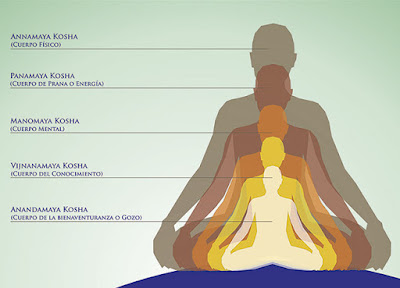
The 5 Sheaths: According the Advaita Vedanta our apparent self is constituted by five Sheaths.

The five sheaths are:
1. Annamaya Kosha (food-sheath),
2. Pranamaya Kosha (vital sheath),
3. Manomaya Kosha (mental sheath),
4. Vijnanamaya Kosha (intellect-sheath)
5. Anandamaya Kosha (blissful sheath).

‘Maya’ means full. ‘Kosha’ means sheath

You can read about the 5 Sheaths in the following text of Swami Sivananda: Discrimination between the Self and the non-self by S. Sivananda  

You van also read the book Vivekachudani: Adisankarcharya Vivekachudamani.pdf

A brief analysis of the different types of self-inquiry

Discerning our Divine Essence from the layers or 5 sheaths

Explore our divine essence beyond the body, energy, mind, intellect, and ego. Self-inquiry reveals the true Self within.

This type of inquiry is based on the teachings of great masters and spiritual traditions that help us to investigate our immediate experience. Based on the knowledge we explore one by one the layers of our apparent existence.

The purpose of this inquiry is to realize that we are not them and to discern our immortal divine essence (Consciousness) from all the layers.

Inquiring into the Psychological structures and tendencies

Dive deep into your psyche. Self-inquiry unveils the layers of your mind, helping you understand, overcome and eliminate egoic tendencies, emotional and mental patterns, false beliefs and overcome psychological issues.

We dedicate time every day at our place to investigate and delve into the issues and psychological reactions and tendencies we have observed during the day manifest in us.

This process allows us to realize their mechanical repetitive nature, their illusory quality, their causes, and consequences. Through this process we realize that we are not these emotional and mental reactions and we become able to stop identifying with them.

Finally, we use certain means, such as prayer, mantras and EFT, to dissolve part of their energy and weaken them as much as possible for the time being.

Short and Long prayer for the dissolution of Ego

However, it is highly recommended this aspect of self-enquiry to be used throughout the day whenever it is necessary to avoid or cease identification with sensory reality or mental and emotional reactions and make them subside.

Establishing our awareness (attention) in the silence space of Consciousness

The self-inquiry is perhaps the most powerful means to cease identifying with psychological expressions and sensory impressions and anchor our attention in the silent space of consciousness.

This type of Self-inquiry is a process by which we withdraw our attention from any objective experience and focus it on the silent space of Consciousness within ourselves. To facilitate this process we use some question or questions such as, “To whom do these thoughts arise?”, or “To whom does this emotion or impulse arise?”, or “To whom does this perception arise?”. The answer is, “To me.” And then we ask: “Who am I?”, or “What am I?”, or also, “What is the source of the Me or I?”.

This aspect of self-enquiry is practiced in both cases, as a seated meditation and as a means of remaining in self-awareness and detached witnesses of the inner and outer world moment by moment throughout the day.

However, this practice can be successfully practiced as the main or only method of practice by mature aspirants who have developed a pure sattvic mind that involves the development of important sattvic qualities or skills such as devotion, self-awareness, detachment, discernment, dispassion, clarity, one-pointedness of mind and steadiness of mind.

Less mature aspirants should follow a more comprehensive practice that will include a variety of practices related to all aspects of our existence aimed at the purification of the mind and heart and vital energy, the elimination of egoic tendencies of all kinds, and the development of the sattvic qualities of mind and heart.

This is the most direct way or method to focus and stabilize our awareness on our essential divine nature and finally establish ourselves in it.

You can read about the practice of Self-enquiry, The Practice of Self-Enquiry Enquiring ‘Who Am I?’ -Ramana Maharshi

The ‘secret’ to a plentiful life, a life of harmony, happiness and contentment is to have a sattvic mind free from desires and ego and to live in every moment in conscious contact with our true Self (Consciousness).

🌺 Peace, Love, Harmony

Friday, April 22, 2022

Aham and Aham-Vritti / Ego and ego Vritti - Ramana Maharshi

Aham and Aham-Vritti  /  Ego and ego Vritti*

In fourteen chapters of the Maharshi's Gospel, Sri Ramana Maharshi answers the full range of doubts that could arise in any seeker that aspires to tread this royal path to eternal freedom. These pointed and well articulated questions are said to be primarily the work of Maurice Frydman. The Maharshi had once commented that Maurice did not ask the questions of the Maharshi's Gospel for his own benefit, implying that these recorded dialogues have an inher value of benefit for generations of earnest seekers the world over. The book, which covers relevant topics and explanations not found elsewhere, was first published in 1939, on Sri Ramana's 60th Birth Anniversary.

Bhagavan Ramana did not just resuscitate the ancient path of Self-enquiry, he, from his own experience, expounded on every aspect of it, clarifying and molding it into an undisputable rational formula that any deep thinking mind can easily grasp and follow. In addition to this, he infused it with his grace and his guiding personality to assist those who follow his path and take refuge in him.

One chapter of particular interest in Maharshi's Gospel (Download pdf  here) is Chapter 6 of Book II, titled "Aham and Aham-Vritti" In it, twenty questions are put to the Maharshi in which he says at one point, the mind becomes introverted through enquiry into the source of aham-vritti (the 'I-thought'), the vasanas become extinct, and in the absence of the reflecting medium, the phenomenon of reflection, namely, the mind, also disappears being absorbed into the light of the one Reality, the Heart. This is the sum and substance of all that an aspirant needs to know.

In spite of this unassailable statement, the questioner continues to dissect the process of how an enquiry into the "I-thought", which is inherently unreal, can reveal the Reality. The Master patiently answers him, eloquently covering every point of doubt. Contemplating these sublime answers, imbibing their innate truth and experiencing the Essence is certainly the foremost duty of every devotee of the Master. 

Aham and Aham-Vritti

D. How can any enquiry initiated by the ego reveal its own unreality?

Maharshi. The ego's phenomenal existence is transcended when you dive into the Source wherefrom arises the aham-vritti.

D. But is not the aham-vritti only one of the three forms in which the ego manifests itself? Yoga Vasishtha and other ancient texts describe the ego as having a threefold form.

Maharshi. It is so. The ego is described as having three bodies, the gross, the subtle and the causal, but that is only for the purposes of analytical exposition. If the method of enquiry were to depend on the ego's form, you might take it that any enquiry would become altogether impossible, because the forms the ego may assume are legion. Therefore, for purposes of jnana-vichara, you have to proceed on the basis that the ego has but one form, namely that of aham-vritti.

D. But it may prove inadequate for realizing jnana.

Maharshi. Self-enquiry, by following the clue of aham-vritti is just like the dog tracing its master by his scent. The master may be at some distant, unknown place, but that does not at all stand in the way of the dog tracing him. The master's scent is an infallible clue for the animal, and nothing else, such as the dress he wears or his build and stature, etc., counts. The dog holds on to that scent undistractedly while searching for him, and finally it succeeds in tracing him.

D. The question still remains why the quest for the source of aham-vritti, as distinguished from other vrittis, should be considered the direct means to Self-realization.

Maharshi. The word "aham" is itself very suggestive. The two letters of the word, namely A (A) and H (HA), are the first and the last letters of the Sanskrit alphabet. The suggestion intended to be conveyed by the word is that it comprises all. How? Because aham signifies existence itself.

Although the concept of "I"-ness or "I-am"-ness is by usage known as aham-vritti, it is not really a vritti like the other vrittis of the mind. Because unlike the other vrittis which have no essential interrelation, the aham-vritti is equally and essentially related to each and every vritti of the mind. Without the aham-vritti there can be no other vritti, but the aham-vritti can subsist by itself without depending on any other vritti of the mind. The aham-vritti is therefore fundamentally different from other vrittis.

So then, the search for the source of the aham-vritti is not merely the search for the basis of one of the forms of the ego but for the very Source itself from which arises the "I-am"-ness. In other words, the quest for and the realization of the source of the ego in the form of aham-vritti necessarily implies the transcendence of the ego in every one of its possible forms.

D. Conceding that the aham-vritti essentially comprises all the forms of the ego, why should that vritti alone be chosen as the means for Self-enquiry?

Maharshi. Because it is the one irreducible datum of your experience; because seeking its source is the only practicable course you can adopt to realize the Self. The ego is said to have a causal body, but how can you make it the subject of your investigation? When the ego adopts that form, you are immersed in the darkness of sleep.

D. But is not the ego in its subtle and causal forms too intangible to be tackled through the enquiry into the source of aham-vritti conducted while the mind is awake?

Maharshi. No. The enquiry into the source of aham-vritti touches the very existence of the ego. Therefore the subtlety of the ego's form is not a material consideration.

D. While the one aim is to realize the unconditioned, pure Being of the Self, which is in no way dependent on the ego, how can enquiry pertaining to the ego in the form of aham-vritti be of any use?

Maharshi. From the functional point of view, the form of the ego or its activity (whatever you may call it is immaterial, since it is evanescent), has one and only one characteristic. The ego functions as the knot between the Self which is pure Consciousness and the physical body which is inert and insentient. The ego is therefore called the chit-jada granthi. In your investigation into the source of aham-vritti, you take the essential chit aspect of the ego: and for this reason the enquiry must lead to the realization of the pure consciousness of the Self.

D. What is the relation between the pure consciousness realized by the jnani and the "I-am"-ness which is accepted as the primary datum of experience?

Maharshi. The undifferentiated consciousness of pure Being is the heart or hridayam which you really are, as signified by the word itself (hrit + ayam = heart am I). From the heart arises the 'I am'-ness as the primary datum of one's experience. By itself it is suddha-sattva in character. It is in this suddha-sattva svarupa (that is, uncontaminated by rajas and tamas), that the 'I' appears to subsist in the jnani".

D. In the jnani the ego subsists in the sattvic form and therefore it appears as something real. Am I right?

Maharshi. No. The existence of the ego in any form, either in the jnani or ajnani, is itself an appearance. But to the ajnani who is deluded into thinking that the waking state and the world are real, the ego also appears to be real. Since he sees the jnani act like other individuals, he feels constrained to posit some notion of individuality with reference to the jnani also.

D. How then does the aham-vritti function in the jnani?

Maharshi. It does not function in him at all. The jnani's lakshya is the heart itself, because he is one and identical with that undifferentiated, pure consciousness referred to by the Upanishads as the Prajnana. Prajnana is verily Brahman, the Absolute, and there is no Brahman other than Prajnana.

D. How then does ignorance of this one and only Reality unhappily arise in the case of the ajnani?

Maharshi. The ajnani sees only the mind which is a mere reflection of the light of pure Consciousness arising from the heart. Of the heart itself he is ignorant. Why? Because his mind is extroverted and has never sought its Source.

D. What prevents the infinite, undifferentiated light of Consciousness arising from the heart from revealing itself to the ajnani?

Maharshi. Just as water in the pot reflects the enormous sun within the narrow limits of the pot, even so the vasanas or latent tendencies of the mind of the individual, acting as the reflecting medium, catch the all-pervading, infinite light of Consciousness arising from the heart and present in the form of a reflection the phenomenon called the mind. Seeing only this reflection, the ajnani is deluded into the belief that he is a finite being, the jiva.

If the mind becomes introverted through enquiry into the source of aham-vritti, the vasanas become extinct, and in the absence of the reflecting medium the phenomenon of reflection, namely, the mind, also disappears being absorbed into the light of the one Reality, the Heart.

This is the sum and substance of all that an aspirant needs know. What is imperatively required of him is an earnest and one-pointed enquiry into the source of aham-vritti.

D. But any endeavor he may make is limited to the mind in the waking state. How can such enquiry conducted in only one of the three states of the mind destroy the mind itself?

Maharshi. Enquiry into the source of aham-vritti is, no doubt, initiated by the sadhaka in the waking state of the mind. It cannot be said that in him the mind has been destroyed. But the process of Self-enquiry will itself reveal that the alter-nation or transmutation of the three states of the mind, as well as the three states themselves, belongs to the world of phenomena which cannot affect his intense, inward enquiry. Self-enquiry is really possible only through intense introversion of the mind. What is finally realized as a result of such enquiry into the source of aham-vritti, is verily the heart as the undifferentiated light of pure Consciousness, into which the reflected light of the mind is completely absorbed.

D. For the jnani, then, there is no distinction between the three states of mind?

Maharshi. How can there be, when the mind itself is dissolved and lost in the light of Consciousness?

For the jnani all the three states are equally unreal. But the ajnani is unable to comprehend this, because for him the standard of reality is the waking state, whereas for the jnani the standard of Reality is Reality itself. This Reality of pure Consciousness is eternal by its nature and therefore subsists equally during what you call waking, dreaming and sleep. To him who is one with that Reality, there is neither the mind nor its three states, and therefore, neither introversion nor extroversion.

His is the ever-waking state, because he is awake to the eternal Self; his is the ever dreaming state, because to him the world is no better than a repeatedly presented phenomenon of dream; his is the ever-sleeping state, because he is at all times without the "body-am-I" consciousness.

D. Should I then consider Sri Bhagavan as talking to me in a waking-dreaming-sleeping state?

Maharshi. Because your conscious experience is now limited to the duration of the extroversion of the mind, you call the present moment the waking state, whereas all the while your mind has been asleep to the Self, and therefore you are now really fast asleep.

D. To me sleep is a mere blankness.

Maharshi. That is so, because your waking state is a mere effervescence of the restless mind.

D. What I mean by blankness is that I am hardly aware of anything in my sleep; it is for me the same as non- existence.

Maharshi. But you did exist during sleep.

D. If I did, I was not aware of it.

Maharshi. You do not mean to say in all seriousness you ceased to exist during your sleep! (Laughing). If you went to sleep as Mr. X, did you get up from it as Mr. Y?

D. I know my identity, perhaps, by an act of memory.

Maharshi. Granting that, how is it possible unless there is a continuity of awareness?

D. But I was unaware of that awareness.

Maharshi. No. Who says you are unaware in sleep? It is your mind. But there was no mind in your sleep? Of what value is the testimony of the mind about your existence or experience during sleep? Seeking the testimony of the mind to disprove your existence or awareness during sleep is just like calling your son's evidence to disprove your birth!

Do you remember, I told you once previously that existence and awareness are not two different things but one and the same? Well, if for any reason you feel constrained to admit the fact that you existed in sleep be sure you were also aware of that existence.

What you were really unaware of in sleep is your bodily existence. You are confounding this bodily awareness with the true Awareness of the Self which is eternal. Prajnana, which is the Source of "I-am"-ness, ever subsists unaffected by the three transitory states of the mind, thus enabling you to retain your identity unimpaired.

Prajnana is also beyond the three states, because it can subsist without them and in spite of them. It is that Reality that you should seek during your so-called waking state by tracing the aham-vritti to its Source. Intense practice in this enquiry will reveal that the mind and its three states are unreal and that you are the eternal, infinite consciousness of pure Being, the Self or the Heart. 

SOURCE:  http://www.arunachala.org/newsletters/2009/jul-aug

NOTE:

Vritti* : Vritti means a whirl-pool. Vrittis are modifications of the mind. It is a wave of thought that arises in the Antahkarana (the fourfold inner instrument/ manas, chitta, buddhi, Ahamkara). ~ Swami Sivananda

The vritti is not referred only to thought but aslo to emotion. feeling and imagination, because all these are modifications of the mind.
Thus when Ramana Maharshi is referred to Aham-vritti this doesn't reffer only to the thought I' but also to the emotional part of I'. The ego is not functioning only when we think the thought I' but almost continuosly creating the sense of I-ness which we identify with the body.

Thus when we perceive we have the sense I' perceive', I' see', I' hear', I' taste' etc.. When thoughts arise in the mind we sense I' think, when emotions, feelings or sensations arise I' feel', when the body acts I' do' etc.

The ego is almost always present in us as a strong sense that we are the body, the perceiver, the enjoyer and the feeler of the various experiences. In self-enquiry we must introvert our mind and our attention in order to trace this strong sense of I-ness to its source. How to do this?  Ramana Maharshi gives his own way, Nisargadatta suggests his own way which is to stay aware of the I am. Each one must do the enquiry based on their instructions but what is most important is to find finally his own way to apply it.

Monday, April 1, 2019

OM! THERE IS NO LIBERATION WITHOUT THE DISSOLUTION OF THE EGO ~ Atman Nityananda


THERE IS NO LIBERATION WITHOUT THE DISSOLUTION OF THE EGO

The great masters and the sacred texts (like Bhagavad Gita) have clarified this subject; therfore there is no doubt that the ego must die completely in order to attain enlightenment or liberation.

Amma (Mata Amritanandamayi) said:

''This rebirth occurs when we completely die to our ego"
"When the last trace of ego disappears, it is then that the real birth of our identity as the Supreme Being takes place within us.
 
Sri Ramana Maharshi said:

 "The spiritual practice adopted by the jiva (the individual, or individual soul) is complete when it destroys the ego in its origin"

"The Ego must, die, must disappear together with the inherent vasanas (desires and egoistic tendencies)."

"The death of the ego in the unlimited Silence (the non-dual Truth) and the shining forth of the Self is the attainment of Oneness (Kaivalya-Siddhi) In that State of Jnana, pure Bliss will gloriously blaze forth as one's own True Nature. "

Swami Sivananda said:

"You cannot realize God if you have the slightest trace of selfishness, or attachment to the name and form, or the slightest nuance of worldly desire in the mind"


´´The true freedom is the liberation from egoism and desires.

´´Freedom lies in the dissolution of the mind. The eradication and annihilation of desires leads to the sublime state of supreme bliss and perfect freedom.--

Sri Sankaracharya wrote in his famous book Vivekachudamani 

" 299. So long as one has any relation to this wicked ego, there should not be the least talk about Liberation, which is unique.''

''300. Freed from the clutches of egoism, as the moon from those of Rahu, man attains to his real nature, and becomes pure, infinite, ever blissful and self-luminous.''
 

''301. That which has been created by the Buddhi extremely deluded by Nescience, and which is perceived in this body as "I am such and such" – when that egoism is totally destroyed, one attains an unobstructed identity with Brahman.''

“303. As long as the slightest residue of poison persists in the victim, total recovery cannot be expected: the ego causes the same effect in a yogi who yearns for liberation.

 
According the gunas the I’ or ego assumes three aspects: the sattvic ego, the rajasic ego and the tamasic ego.

However I prefer to classify the ego in two categories. The sattvic ego (or superior ego) and rajasotamasic ego (the inferior ego).

I prefer this classification because the rajasic and tamasic aspects of the ego are what impede us to live harmoniously and aware of our true nature, while the sattvic ego is what is helping us move from the darkness of materialism, the identification with the body and the lower mind, to the light of consciousness and the divine life. 

The lower ego (of Rajasotamasic nature) causes our identification with the body and all other identifications, and  is a sum of selfish tendencies such as pride, greed, lasciviousness, gluttony, envy, anger, fear, taste, disgust, hatred etc.. 

The higher ego (of sattvic nature) that is what gives us individuality and identifies with the Self (Atman, Consciousness) and not with the body.


In order to achieve liberation, the lower ego must be dissolved completely. Without the death of the lower ego there is neither enlightenment, nor liberation, nor self-realization. Awakening can happen before the total dissolution of the lower ego,  but awakening it isn’t  the end of the journey.

The liberated one (Jivnamukta) in order to be able to communicate his teachings to this 3D world, he must maintain his individuality; and according to the great masters (such as Swami Sivananda, Sri Ramana Maharshi and Amma) this happens because of a residue of the sattvic ego. This residue of the sattvic ego has nothing to do with the ego that causes the identifications, the attachments, the dysfunctions and the suffering; these happen due to the lower rajasotamasic ego.
 

The liberated has no identification of any kind and all egoic tendencies (pride, desires, greed, greed, jealousy, lasciviousness, gluttony, etc.) are dissolved forever. The Jivanmukta has no identification with his body, the mind, the senses, the objects, etc.

The liberated one is rooted and established in his essential nature (Atman, Consciousness) without having any kind of identity.

"Even in a Jivanmukta (Liberated) there is a slight trace of sattvic egoism. The Jivanmukta performs actions through this sattvic selfishness " ~  Swami Sivananda

Friday, July 22, 2016

Aham and Aham-Vritti / Sri Ramana Maharshi


Aham and Aham-Vritti  /  Ego and ego Vritti*
In fourteen chapters of the Maharshi's Gospel, Sri Ramana Maharshi answers the full range of doubts that could arise in any seeker that aspires to tread this royal path to eternal freedom. These pointed and well articulated questions are said to be primarily the work of Maurice Frydman. The Maharshi had once commented that Maurice did not ask the questions of the Maharshi's Gospel for his own benefit, implying that these recorded dialogues have an inher value of benefit for generations of earnest seekers the world over. The book, which covers relevant topics and explanations not found elsewhere, was first published in 1939, on Sri Ramana's 60th Birth Anniversary.

Bhagavan Ramana did not just resuscitate the ancient path of Self-enquiry, he, from his own experience, expounded on every aspect of it, clarifying and molding it into an undisputable rational formula that any deep thinking mind can easily grasp and follow. In addition to this, he infused it with his grace and his guiding personality to assist those who follow his path and take refuge in him.

One chapter of particular interest in Maharshi's Gospel (Download pdf  here) is Chapter 6 of Book II, titled "Aham and Aham-Vritti" In it, twenty questions are put to the Maharshi in which he says at one point, the mind becomes introverted through enquiry into the source of aham-vritti (the 'I-thought'), the vasanas become extinct, and in the absence of the reflecting medium, the phenomenon of reflection, namely, the mind, also disappears being absorbed into the light of the one Reality, the Heart. This is the sum and substance of all that an aspirant needs to know.

In spite of this unassailable statement, the questioner continues to dissect the process of how an enquiry into the "I-thought", which is inherently unreal, can reveal the Reality. The Master patiently answers him, eloquently covering every point of doubt. Contemplating these sublime answers, imbibing their innate truth and experiencing the Essence is certainly the foremost duty of every devotee of the Master. 

Aham and Aham-Vritti

D. How can any enquiry initiated by the ego reveal its own unreality?

Maharshi. The ego's phenomenal existence is transcended when you dive into the Source wherefrom arises the aham-vritti.

D. But is not the aham-vritti only one of the three forms in which the ego manifests itself? Yoga Vasishtha and other ancient texts describe the ego as having a threefold form.

Maharshi. It is so. The ego is described as having three bodies, the gross, the subtle and the causal, but that is only for the purposes of analytical exposition. If the method of enquiry were to depend on the ego's form, you might take it that any enquiry would become altogether impossible, because the forms the ego may assume are legion. Therefore, for purposes of jnana-vichara, you have to proceed on the basis that the ego has but one form, namely that of aham-vritti.

D. But it may prove inadequate for realizing jnana.

Maharshi. Self-enquiry, by following the clue of aham-vritti is just like the dog tracing its master by his scent. The master may be at some distant, unknown place, but that does not at all stand in the way of the dog tracing him. The master's scent is an infallible clue for the animal, and nothing else, such as the dress he wears or his build and stature, etc., counts. The dog holds on to that scent undistractedly while searching for him, and finally it succeeds in tracing him.

D. The question still remains why the quest for the source of aham-vritti, as distinguished from other vrittis, should be considered the direct means to Self-realization.

Maharshi. The word "aham" is itself very suggestive. The two letters of the word, namely A (A) and H (HA), are the first and the last letters of the Sanskrit alphabet. The suggestion intended to be conveyed by the word is that it comprises all. How? Because aham signifies existence itself.

Although the concept of "I"-ness or "I-am"-ness is by usage known as aham-vritti, it is not really a vritti like the other vrittis of the mind. Because unlike the other vrittis which have no essential interrelation, the aham-vritti is equally and essentially related to each and every vritti of the mind. Without the aham-vritti there can be no other vritti, but the aham-vritti can subsist by itself without depending on any other vritti of the mind. The aham-vritti is therefore fundamentally different from other vrittis.

So then, the search for the source of the aham-vritti is not merely the search for the basis of one of the forms of the ego but for the very Source itself from which arises the "I-am"-ness. In other words, the quest for and the realization of the source of the ego in the form of aham-vritti necessarily implies the transcendence of the ego in every one of its possible forms.

D. Conceding that the aham-vritti essentially comprises all the forms of the ego, why should that vritti alone be chosen as the means for Self-enquiry?

Maharshi. Because it is the one irreducible datum of your experience; because seeking its source is the only practicable course you can adopt to realize the Self. The ego is said to have a causal body, but how can you make it the subject of your investigation? When the ego adopts that form, you are immersed in the darkness of sleep.

D. But is not the ego in its subtle and causal forms too intangible to be tackled through the enquiry into the source of aham-vritti conducted while the mind is awake?

Maharshi. No. The enquiry into the source of aham-vritti touches the very existence of the ego. Therefore the subtlety of the ego's form is not a material consideration.

D. While the one aim is to realize the unconditioned, pure Being of the Self, which is in no way dependent on the ego, how can enquiry pertaining to the ego in the form of aham-vritti be of any use?

Maharshi. From the functional point of view, the form of the ego or its activity (whatever you may call it is immaterial, since it is evanescent), has one and only one characteristic. The ego functions as the knot between the Self which is pure Consciousness and the physical body which is inert and insentient. The ego is therefore called the chit-jada granthi. In your investigation into the source of aham-vritti, you take the essential chit aspect of the ego: and for this reason the enquiry must lead to the realization of the pure consciousness of the Self.

D. What is the relation between the pure consciousness realized by the jnani and the "I-am"-ness which is accepted as the primary datum of experience?

Maharshi. The undifferentiated consciousness of pure Being is the heart or hridayam which you really are, as signified by the word itself (hrit + ayam = heart am I). From the heart arises the 'I am'-ness as the primary datum of one's experience. By itself it is suddha-sattva in character. It is in this suddha-sattva svarupa (that is, uncontaminated by rajas and tamas), that the 'I' appears to subsist in the jnani".

D. In the jnani the ego subsists in the sattvic form and therefore it appears as something real. Am I right?

Maharshi. No. The existence of the ego in any form, either in the jnani or ajnani, is itself an appearance. But to the ajnani who is deluded into thinking that the waking state and the world are real, the ego also appears to be real. Since he sees the jnani act like other individuals, he feels constrained to posit some notion of individuality with reference to the jnani also.

D. How then does the aham-vritti function in the jnani?

Maharshi. It does not function in him at all. The jnani's lakshya is the heart itself, because he is one and identical with that undifferentiated, pure consciousness referred to by the Upanishads as the Prajnana. Prajnana is verily Brahman, the Absolute, and there is no Brahman other than Prajnana.

D. How then does ignorance of this one and only Reality unhappily arise in the case of the ajnani?

Maharshi. The ajnani sees only the mind which is a mere reflection of the light of pure Consciousness arising from the heart. Of the heart itself he is ignorant. Why? Because his mind is extroverted and has never sought its Source.

D. What prevents the infinite, undifferentiated light of Consciousness arising from the heart from revealing itself to the ajnani?

Maharshi. Just as water in the pot reflects the enormous sun within the narrow limits of the pot, even so the vasanas or latent tendencies of the mind of the individual, acting as the reflecting medium, catch the all-pervading, infinite light of Consciousness arising from the heart and present in the form of a reflection the phenomenon called the mind. Seeing only this reflection, the ajnani is deluded into the belief that he is a finite being, the jiva.

If the mind becomes introverted through enquiry into the source of aham-vritti, the vasanas become extinct, and in the absence of the reflecting medium the phenomenon of reflection, namely, the mind, also disappears being absorbed into the light of the one Reality, the Heart.

This is the sum and substance of all that an aspirant needs know. What is imperatively required of him is an earnest and one-pointed enquiry into the source of aham-vritti.

D. But any endeavor he may make is limited to the mind in the waking state. How can such enquiry conducted in only one of the three states of the mind destroy the mind itself?

Maharshi. Enquiry into the source of aham-vritti is, no doubt, initiated by the sadhaka in the waking state of the mind. It cannot be said that in him the mind has been destroyed. But the process of Self-enquiry will itself reveal that the alter-nation or transmutation of the three states of the mind, as well as the three states themselves, belongs to the world of phenomena which cannot affect his intense, inward enquiry. Self-enquiry is really possible only through intense introversion of the mind. What is finally realized as a result of such enquiry into the source of aham-vritti, is verily the heart as the undifferentiated light of pure Consciousness, into which the reflected light of the mind is completely absorbed.

D. For the jnani, then, there is no distinction between the three states of mind?

Maharshi. How can there be, when the mind itself is dissolved and lost in the light of Consciousness?

For the jnani all the three states are equally unreal. But the ajnani is unable to comprehend this, because for him the standard of reality is the waking state, whereas for the jnani the standard of Reality is Reality itself. This Reality of pure Consciousness is eternal by its nature and therefore subsists equally during what you call waking, dreaming and sleep. To him who is one with that Reality, there is neither the mind nor its three states, and therefore, neither introversion nor extroversion.

His is the ever-waking state, because he is awake to the eternal Self; his is the ever dreaming state, because to him the world is no better than a repeatedly presented phenomenon of dream; his is the ever-sleeping state, because he is at all times without the "body-am-I" consciousness.

D. Should I then consider Sri Bhagavan as talking to me in a waking-dreaming-sleeping state?

Maharshi. Because your conscious experience is now limited to the duration of the extroversion of the mind, you call the present moment the waking state, whereas all the while your mind has been asleep to the Self, and therefore you are now really fast asleep.

D. To me sleep is a mere blankness.

Maharshi. That is so, because your waking state is a mere effervescence of the restless mind.

D. What I mean by blankness is that I am hardly aware of anything in my sleep; it is for me the same as non- existence.

Maharshi. But you did exist during sleep.

D. If I did, I was not aware of it.

Maharshi. You do not mean to say in all seriousness you ceased to exist during your sleep! (Laughing). If you went to sleep as Mr. X, did you get up from it as Mr. Y?

D. I know my identity, perhaps, by an act of memory.

Maharshi. Granting that, how is it possible unless there is a continuity of awareness?

D. But I was unaware of that awareness.

Maharshi. No. Who says you are unaware in sleep? It is your mind. But there was no mind in your sleep? Of what value is the testimony of the mind about your existence or experience during sleep? Seeking the testimony of the mind to disprove your existence or awareness during sleep is just like calling your son's evidence to disprove your birth!

Do you remember, I told you once previously that existence and awareness are not two different things but one and the same? Well, if for any reason you feel constrained to admit the fact that you existed in sleep be sure you were also aware of that existence.

What you were really unaware of in sleep is your bodily existence. You are confounding this bodily awareness with the true Awareness of the Self which is eternal. Prajnana, which is the Source of "I-am"-ness, ever subsists unaffected by the three transitory states of the mind, thus enabling you to retain your identity unimpaired.

Prajnana is also beyond the three states, because it can subsist without them and in spite of them. It is that Reality that you should seek during your so-called waking state by tracing the aham-vritti to its Source. Intense practice in this enquiry will reveal that the mind and its three states are unreal and that you are the eternal, infinite consciousness of pure Being, the Self or the Heart. 

SOURCE:  http://www.arunachala.org/newsletters/2009/jul-aug

NOTE:

Vritti* : Vritti means a whirl-pool. Vrittis are modifications of the mind. It is a wave of thought that arises in the Antahkarana (the fourfold inner instrument/ manas, chitta, buddhi, Ahamkara). ~ Swami Sivananda

The vritti is not referred only to thought but aslo to emotion. feeling and imagination, because all these are modifications of the mind.
Thus when Ramana Maharshi is referred to Aham-vritti this doesn't reffer only to the thought I' but also to the emotional part of I'. The ego is not functioning only when we think the thought I' but almost continuosly creating the sense of I-ness which we identify with the body.

Thus when we perceive we have the sense I' perceive', I' see', I' hear', I' taste' etc.. When thoughts arise in the mind we sense I' think, when emotions, feelings or sensations arise I' feel', when the body acts I' do' etc.

The ego is almost always present in us as a strong sense that we are the body, the perceiver, the enjoyer and the feeler of the various experiences. In self-enquiry we must introvert our mind and our attention in order to trace this strong sense of I-ness to its source. How to do this?  Ramana Maharshi gives his own way, Nisargadatta suggests his own way which is to stay aware of the I am. Each one must do the enquiry based on their instructions but what is most important is to find finally his own way to apply it.



Sunday, July 17, 2016

Enlightenment or Liberation (Moksha) . Sri Ramana Maharshi


Enlightenment or Liberation (Moksha)

Kavyakantha Ganapati Sastri:
Kavyakantha Ganapati Sastri: For Moksha (release from the bondage of samsara) sadhana (i.e., means to be adopted for practice) has to be considered. Some seem to opine that all that is necessary is Satyaa-satya viveka, the (careful) discrimination between what is ultimate truth or reality and what is not such truth or reality. Is that sufficient? Or is it necessary to adopt other means also? Maharshi: Moksha is release from bondage; bondage is really ignorance; and ignorance can only be expelled by enlightenment. If the expulsion is to be complete and permanent, the enlightenment also must be complete and permanent. That is, one must always remain realizing That. Remaining in the realization of That is termed Atmanishta. This alone removes all bondage, that is, secures Moksha.

K.G.S.: But is not viveka the means to secure Atmanishta?

Maharshi: Viveka is the discrimination of the (eternal) Real from the unreal. It helps to secure vairagya, dispassion or freedom from emotions such as joy, sorrow, etc., which disturb the placidity and equanimity of one's mind, and thus viveka proves to be a useful and a necessary preparation for attaining Atmanishta, i.e. firmness in Jnana (Enlightenment.) The knowledge of Satya or the Real secured by viveka (discrimination) is not the same as (but only the basis of) Jnana (Enlightenment) or Atmanishta (i.e., firm self-realization). The former is still in the stage of chitta-vritti, an intellectual process, while the latter is not that at all, but is intuition, something in which the chitta (mind or intellect) has ceased its activities. The former state still retains the duality of reality and unreality, and the contrast between the two. In the latter, i.e., the state of the Jnani, all contrasts and duality are swallowed up and there is only ineffable Realization. The intellectual viveki knows and reasons mediately (paroksha). The intuitive Jnani feels the truth, the Real, directly and immediately (aparoksha). The Jnani is not like the intellectual viveki. He regards the Jagat (Visvam), i.e., the phenomenal universe, as unreal, or as in no way different from himself, the Self.

K.G.S.: Is sastra charcha, the study and exploration of scripture, sufficient to attain Moksha, or should one seek the aid of a Guru and practice meditation (i.e., upasana) to attain Jnana (realization)?

Maharshi: Mere scriptural learning is insufficient. Certainly, practice of meditation and concentration is needed for realization. But what does that term upasana (practice) imply? It means that the aspirant is still conscious of his separate individuality and fancies himself to be making efforts to attain something — some Jnana not yet known to be himself. He ultimately arrives at the truth, the realization that all the time (including the time of practice) he has been (as he is and will be) himself the Self — beyond the concept of time. Though it is that state of realization (Sahaja Sthithi), or natural state of the Self that has been throughout all the time of practice (as nothing else exist), he calls it "upasana" or practice of meditation, because his realization is not yet perfected; he, the thinker, or the subject, fancies he is going through a process of thinking or meditation upon an object, viz. Ishwara. When perfected, his state is termed Jnana, or Sahaja Sthithi, or the Atman, or Swabhava Samsthithi, or Sthitha Prajnatvam. It may be described further as the state when vishaya jnanam, i.e., knowledge of the objective world, the non-self, has been entirely effaced and nothing remains but a blaze of consciousness of the Self as the Self (Swabhava Samsthithi).

K.G.S.: Does the aspirant after he attains firm Enlightenment (Sthitha Prajnatvam) retain a sense of his personality (self-consciousness)? Is he aware then that he has attained perfectly firm Enlightenment; and does he perceive that (1) from the entire effacement of his knowledge of the objective world or non-self, or (2) from perfection of his Enlightenment (Prajnatvam)?

Maharshi: Yes, the perfectly Enlightened, the fully attained Jnani, the Self-realized, certainly realizes himself as such. There can be no doubt there. Doubt or uncertainty is for the mind or intellect, and has no place in that perfection of Realization or Enlightenment. Perfection is seen (1) by a negative sign, the cessation of all vasanas, i.e., tendencies of the mind to act in consequence of previous "attached karma" (action), and (2) by the positive sign of his incessant consciousness (Chidatmakaratha), which is also termed "Mownam". As for perfection of Jnana, the distinction is often drawn between Jnana and Vijnana, the latter referring to realization. The Jnani is said to be not merely Jnana-Swarupa, i.e., of the nature of Enlightenment, but also Swatmarama or Anandamurti, which means that he is experiencing and enjoying the Self as Jnanam or Anandam. But this is a dualistic metaphor. In point of fact, that which is (Sat), is but one. There is no separate thing as its enjoyment, or an object, or a quality for it to enjoy. But thought has to be expressed to others "in matter-moulded forms of speech" and so we proceed into finer and finer analysis by means of similes, metaphors, etc., even as the Reality defies expression. On account of the use of such figurative language, however, the question is raised whether the Jnani experiences or realizes his Jnanam. What remains after all elimination is best described as Sat, that which is, Chit, consciousness or illumination, and Anandam or happiness — all three terms referring to one and the same substance. That is really not existence, nor illumination, nor happiness, nor substance, nor personality as we conceive them now. But these are the expressions or ideas which suggest to us that Supreme State, that goal, "Sa kashtha sa para gatih," That is Supreme, That the highest goal. (Katha Upanishad I-3-11)

K.G.S.: Well, the Jnani knows himself as such, i.e., as the fully attained. But can others know him to be such, and if so, by what indication?

Maharshi: Yes, it can be known. The mark by which perfect realization is indicated is Sarvabhuta Samattva, which means equality or sameness toward all. When one finds the same Atma or Self in all the various moveable and immoveable objects and his behaviour indicates the sense of equality, that constitutes the hallmark of the Jnani, Gunatita, Brahman, etc., as he is variously called. Equality means here, in practice, the accordance of treatment appropriate to each, without undue preference or undue avoidance as described in the Bhagavad Gita:

32. He who, through the likeness of the Self, O Arjuna, sees equality everywhere, be it pleasure or pain, he is regarded as the highest yogi. (Chap. VI)

24 & 25. Who is the same in pleasure and pain, who dwells in the Self, to whom a clod of earth, stone and gold are alike, who is the same to the dear and the unfriendly, who is firm, and to whom censure and praise are as one, who is the same in honour and dishonour, the same to friend and foe, abandoning all undertakings — he is said to have transcended the qualities. (Chap. XIV)

K.G.S.: Does the practice of yoga culminating in samadhi (absorbed concentration or ecstasy) serve only the purpose of Self-realization or can it be utilized to secure also other and lower objects, such as the attainment of temporal ends?

Maharshi: Why, samadhi (i.e., the Yogi's perfect concentration) serves both purposes — Self-realization and the securing of lower objects.

K.G.S.: If one starts his practice of yoga and develops samadhi (absorbed concentration) to secure lesser objects, and before attaining these attains the greater object of Self-realization, what happens about the lesser objects? Does he attain these also or does he not?

Maharshi: He does. The karma (or effort) to reach lesser objects does not cease to produce its result and he may succeed in achieving these even after securing Self-realization. Of course, on account of such realization, there will be no exultation or joy at the lesser successes. For that which feels emotion, the mind, has ceased to exist in him as such, and has been transmuted into Prajna, Cosmic Consciousness.

SOURCE: http://www.arunachala.org/newsletters/2009/jul-aug

Wednesday, March 30, 2016

Om! How is one to enquire: "Who am I?" ~ Sri Ramana Maharshi


How is one to enquire: "Who am I?"  
 ~ Sri Ramana Maharshi

Disciple: Master! What is the means to gain the state of eternal bliss, ever devoid of misery?

RAMANA MAHARSHI: Apart from the statement in the Veda that wherever there is body there is misery, this is also the direct experience of all people; therefore, one should enquire into one's true nature which is ever bodiless, and one should remain as such. This is the means to gaining that state.

Disciple: What is meant by saying that one should enquire into one's true nature and understand it?

RAMANA MAHARSHI: Experiences such as "I went; I came; I was; I did" come naturally to everyone. From these experiences, does it not appear that the consciousness "I" is the subject of those various acts? Enquiry into the true nature of that consciousness, and remaining as oneself is the way to understand, through enquiry, one's true nature.

Disciple: How is one to enquire: "Who am I?"

RAMANA MAHARSHI: Actions such as 'going' and 'coming' belong only to the body. And so, when one says "I went, I came", it amounts to saying that the body is "I". But, can the body be said to be the consciousness "I", since the body was not before it was born, is made up of the five elements, is non-existent in the state of deep sleep, and becomes a corpse when dead? Can this body which is inert like a log of wood be said to shine as "I" "I"? Therefore, the "I" consciousness which at first arises in respect of the body is referred to variously as self-conceit (tarbodham), egoity (ahankara), nescience (avidya), maya, impurity (mala), and individual soul (jiva) . Can we remain without enquiring into this? Is it not for our redemption through enquiry that all the scriptures declare that the destruction of "self-conceit" is release (mukti)? '". Then, there would shine in the Heart a kind of wordless illumination of the form 'I' 'I'. That is, there would shine of its own accord the pure consciousness which is unlimited and one, the limited and the many thoughts having disappeared. If one remains quiescent without abandoning that (experience), the egoity, the individual sense, of the form 'I am the body' will be totally destroyed, and at the end the final thought, viz. the 'I'-form also will be quenched like the fire that burns camphor*. The great sages and scriptures declare that this alone is release Therefore, making the corpse-body remain as a corpse, and not even uttering the word "I", one should enquire keenly thus: "Now, what is it that rises as 'I.

* i.e., without leaving any sediment.

Disciple: When one enquires into the root of 'self conceit' which is of the form 'I', all sorts of different thoughts without number seem to rise; and not any separate 'I' thought.

RAMANA MAHARSHI: Whether the nominative case, which is the first case, appears or not, the sentences in which the other cases appear have as their basis the first case; similarly, all the thoughts that appear in the heart have as their basis the egoity which is the first mental mode 'I', the cognition of the form 'I am the body'; thus, it is the rise of egoity that is the cause and source of the rise of all other thoughts; therefore, if the self-conceit of the form of egoity which is the root of the illusory tree of samsara (bondage consisting of transmigration) is destroyed, all other thoughts will perish completely like an uprooted tree. Whatever thoughts arise as obstacles to one's sadhana (spiritual discipline) - the mind should not be allowed to go in their direction, but should be made to rest in one's self which is the Atman; one should remain as witness to whatever happens, adopting the attitude 'Let whatever strange things happen, happen; let us see!' This should be one's practice. In other words, one should not identify oneself with appearances; one should never relinquish one's self.

This is the proper means for destruction of the mind (manonasa) which is of the nature of seeing the body as self, and which is the cause of all the aforesaid obstacles. This method which easily destroys egoity deserves to be called devotion (bhakti), meditation (dhyana), concentration (yoga), and knowledge (jnana). Because God remains of the nature of the Self, shining as 'I' in the heart, because the scriptures declare that thought itself is bondage, the best discipline is to stay quiescent without ever forgetting Him (God, the Self), after resolving in Him the mind which is of the form of the 'I'-thought, no matter by what means. This is the conclusive teaching of the Scriptures.

Disciple: Is enquiry only the means for removal of the false belief of selfhood in the gross body, or is it also the means for removal of the false belief of selfhood in the subtle and causal bodies?

RAMANA MAHARSHI: It is on the gross body that the other bodies subsist. In the false belief of the form "I am the body" are included all the three bodies consisting of the five sheaths. And destruction of the false belief of selfhood in the gross body is itself the destruction of the false belief of selfhood in the other bodies. So inquiry is the means to removal of the false belief of selfhood in all the three bodies. 
extract from the book self_enquiry.pdf