Join Online Spiritual Academy

Atman On Substack

ATMAN NITYANANDA - SUBSTACK
Walk the Path of Truth & Freedom

Help Atman's Mission to Flourish

Help Atman's Mission to Flourish
Greatfull for Your Support !
Showing posts with label koshas - Bodies. Show all posts

Tuesday, November 7, 2023

Om! The Bliss sheath or Causal body (Anandamaya Kosha) - Atman Nityananda

 
The Bliss sheath or Causal body (Anandamaya Kosha)

 The bliss sheath (or vehicle of the Self) is considered to be the primordial ignorance and, although originally sattvic in nature, is tainted by the gunas rajas and tamas. It is also called the causal body and is the substratum of all other sheaths (physical sheath, pranic sheath, mental sheath and intellectual sheath) and contains in seed form all tendencies and desires of any nature (sattvic, rajasic and tamasic).

The Anandamaya Kosha (bliss sheath) has three modes of expression. First is the joy we feel on seeing the desired object (this joy is called Priya in Sanskrit). The joy we experience by possessing the desired object (this joy is called Moda) and the joy or happiness we experience through the actual enjoyment of the desired object (this joy is called Pramoda). 

This Anandamaya Kosha in the dream and waking states is partially expressed in the vision of pleasant objects and when we do well or succeed in something, and is fully expressed during deep sleep. We also experience spontaneously the happiness of the Anandamaya kosha when our virtuous deeds of the past come to fruition.

The Anandamaya sheath, as well as all other sheaths, are not the Self (Consciousness), but temporary vehicles of Consciousness to experience itself and express all its potentialities.

The sheath of joy, when impure, veils our true Self and prevents us from experiencing the peace and joy of our Soul (Atman, Consciousness). When it is purified of rajas and tamas and freed from the seeds of selfish tendencies and desires, then it clearly reflects the bliss of our divine Self.

We identify with the ignorance, joy, happiness and contentment of the Anandamaya sheath and also with the other sheaths (The physical body, prana, mind and intellect), because of ignorance and non-discrimination, that is, because we are not aware of our true Self which is beyond and distinct from the Anandamaya and all other sheaths and we do not have the ability to discern between, our true Self, the eternal Sat-Chit-Ananda Consciousness (Atman) and the five sheaths.

We are aware of the joy of the Anandamaya sheath, as well as of bodily and energetic sensations, mental, emotional and intellectual expressions, thanks to the light of Consciousness that illuminates them. Just as the light of the sun is distinct from the objects it illuminates, Consciousness is distinct from the five sheaths of which we can be aware thanks to that light of Consciousness.

Given that Consciousness is experienced mixed with the five sheaths, in order to recognize and be fully aware of our true Self, we must, through one-pointed discriminative enquiry, discern the silent presence of Consciousness from the five sheaths, i.e., the body, vital energy, thoughts, emotions, reasoning and the joy, and also meditate on it (the silent presence of Consciousness) until all identifications with the five sheaths cease completely. The complete cessation of identifications involves the elimination of the egoic self with all its tendencies and desires.

Sunday, March 6, 2016

Om! Discrimination between the Self (Atman) and the non-self (5 koshas) ~ Swami Sivananda


Discrimination between the Self (Atman) and the non-self (5 koshas)
by Swami Sivananda  

Extract from Atman is Distinct from the Pancha Koshas (five bodies) by Swami Sivananda

Just as the clouds which are generated by the rays of the sun, and which exist only on account of the sun cover the sun, just as the smoke which has its existence through fire conceals the fire, just as the snake in the rope which owes its existence to the rope hides the rope, just as the jar which exists on account of the clay conceals the clay, just as the ear-rings which owe their existence to the gold hide the gold, the five Koshas which owe their very existence to the Atman cover the very Atman.

The Atman transcends the five sheaths. It is entirely distinct from the five sheaths. You will have to pierce through these five sheaths if you want to get knowledge of the Self. These five sheaths form a cave (Guha) and the Atman is hidden in the cave. The self-effulgent Atman shines in the midst of Pranas within the heart.

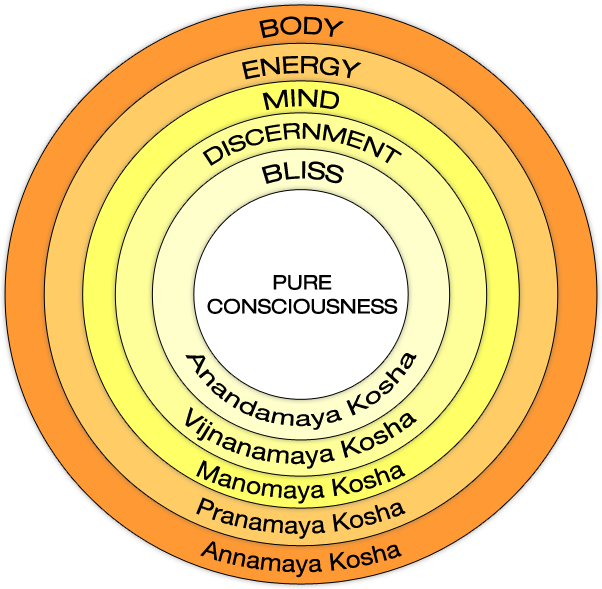
The five sheaths are:
1. Annamaya Kosha (food-sheath),
2. Pranamaya Kosha (vital sheath),
3. Manomaya Kosha (mental sheath),
4. Vijnanamaya Kosha (intellect-sheath)
5. and Anandamaya Kosha (blissful sheath).

'Maya' means full. 'Kosha' means sheath

Just as the scabbard hides the sword, the outer shell covers the tamarind fruit, the coat covers the body, so also these five sheaths hide the Atman. Hence the significant name Kosha. Just as the Kosakar worm gets itself bound in its nest, so also the Jiva gets himself bound within the Koshas.
  1. The Annamaya Kosha forms the gross body. 
  2. The Pranamaya, Manomaya, Vijnanamaya Koshas go to constitute the subtle or astral body or Linga Sarira. 
  3. The Anandamaya Kosha forms the causal body or Karana Sarira. 
The five Karma Indriyas (mouth or speech organ, hands or working organs, legs or locomotion organs, excretory organ and reproductory organ) are contained in the Pranamaya Kosha. The five Jnana Indriyas (eyes-see, ears-hear, tongue-taste, skin-touch and nose-smell) are contained in the Manomaya Kosha.

There is an illusory connection between the Koshas and Atman through Anyonya Adhyasa or mutual superimposition by which the Dharmas or attributes of the Koshas appear on the Atman and the Dharmas of the Atman on the Koshas.

It is the innate tendency of the human mind to identify the Self with the five Koshas. This is due to ignorance (Avidya) only. This is due to Adhyasa or superimposition. 

The ignorant man of dull intellect identifies the Self with the physical body. Others identify the Self or Atman with Prana, mind, intellect, or the Karana Sarira according to their various grades of intelligence.

Ignorance and non-discrimination

All this illusion has arisen in men on account of ignorance and non-discrimination or absence of the faculty which discriminates between the eternal Atman and the illusory five sheaths which are falsely superimposed upon the Atman. 

The five sheaths are creations by the mind on account of ignorance. The five sheaths cannot be the pure, self-existent, self-luminous Atman. Srutis emphatically declare that the Atman is bodiless. Just as the changes that take place in the cow such as growth, decay, etc., do not in the least affect the proprietor of the cow, the seer, so also the changes that occur in the five sheaths do not touch their proprietor and seer, the Atman.


Just as you can clearly distinguish the sound of one man from another through the power of discrimination; just as you can clearly feel, this is soft, this is hard, this is hot, this is cold, by the power of discrimination; just as you can clearly understand by looking at a picture on a wall, this is black colour, this is red colour, this is wall, this is a picture, through the power of discrimination, although you are not able to separate the red colour from the black colour, the picture from the wall; just as you can clearly understand by tasting a drink, this is lemonade, this is orange, this is raspberry, through the power of discrimination, although you cannot separate the salt or sugar from the water; just as you can know the odour in a cloth by the organ of smell although you cannot separate the odour from the cloth; so also you can clearly differentiate Atman and the Koshas by understanding the essential nature of Atman and the five sheaths, by hearing Vedanta from a Guru. You can clearly understand that there is no connection between the Atman and the five sheaths. 

Although it is impossible for ordinary people to separate water from milk, yet it is possible for a Hamsa (swan) to separate water from milk. Although it is impossible for people of gross intellect to differentiate Atman from the five sheaths, yet it is possible for a man of subtle intellect to differentiate between them.

The five sheaths are not really in Atman. Just as the snake is superimposed upon the rope, silver on the mother-of-pearl, thief on the post, water in the mirage, blueness in the sky, so also the five sheaths are superimposed on the Atman on account of ignorance. Just as the illusion of snake vanishes when the knowledge of rope is attained, so also the erroneous conception of the five sheaths disappears when one gets knowledge of the Self.

A detailed knowledge and comprehensive understanding of the five sheaths is an indispensable requisite, if you want to attain Self-realisation and practise the 'Neti-neti' doctrine of Vedanta.
NOTE:
A student who treads the path of Truth (especially the path of Jnana yoga y Vedanta) must first equip himself with Sadhana Chatushtaya - the "four means of salvation".

1. discrimination, (Viveka)
2. dispassion, (Vairagya)
3. the sixfold qualities of perfection, (Shad-Sampat )
4. and intense longing for liberation, (Mumukshutva)

Read also the related essays:

Read the book:
Moksha Gita(.pdf) : an exhaustive treatise of the highest wisdom of the Advaita Vedanta.
A study of Moksha Gita alone is enough to guide a sincere aspirant in the path of Jnana-Yoga.
By practicing its teachings one gets liberated from all bondage and becomes Immortal

Thursday, February 4, 2016

THE YOGA OF NUTRITION by Aivanhov, Omraam Mikhael


THE YOGA OF NUTRITION
by Aivanhov, Omraam Mikhael

Have you ever stopped to think about the power of the elements contained in food, or about the fact that, when it comes to getting you back on your feet again, a meal is always far more effective than any thought or emotion or effort of the will?

The unknown power of food
You consider food to be important only on the level of your instincts, you don’t think it has any importance on the level of your intellectual or conscious life, and yet it is the only thing capable of restoring health and energy. Thanks to the food you eat you can continue to act, to speak, to feel and to think.

Initiates have always devoted a considerable proportion of their time to research concerning nutrition. They have found that food, which is prepared with unutterable wisdom in the laboratories of the Lord, contains magic elements capable not only of preserving or restoring both our physical and our psychic health, but also of revealing great wonders to us. But if we wish to benefit from these magic elements we must first know the conditions we have to fulfil.

No one can fail to recognize that the question of food is in the forefront of everyone’s preoccupations. It is the very first problem that has to be taken care of: this is what men and women work for every day of their lives. Indeed, this is what they even go to war for: many wars and revolutions have had no other cause than that of food! But this attitude towards food is simply an instinct which human beings have in common with animals: they have not yet understood the spiritual importance of the act of eating. In fact they have no notion of how to eat. Watch people during a meal and you will see that they absorb their food mechanically, unconsciously. They swallow everything without chewing it; their heads and their hearts are seething with chaotic ideas and emotions, and often enough they even quarrel amongst themselves while they are eating. No wonder they make themselves ill: all their functions are upset; nothing works as it should any more, neither digestion nor secretions nor the elimination of toxic wastes.

Thousands of people make themselves ill in this way without an inkling that their problems are caused by the way they eat. You only need to observe what takes place in many families: before a meal no one has anything to say to the others, they are all busy reading or listening to the radio or doing their own little job. But as soon as it is time to eat, they all have some story to tell or even some old score to settle, and the meal is spent in talking, arguing and quarrelling. After a meal of that kind they feel sluggish and sleepy and need a rest, or even a nap, and those who have to go back to work do so without zest or enthusiasm. Whereas someone who knows how to eat correctly is clear-headed and alert after a meal.

How we should eat
Perhaps you are now wondering how you should eat. Well, let me talk to you about how an Initiate considers this question of eating. With a view to giving himself the best possible conditions in which to receive the elements that have been put into his food in Nature’s laboratories, an Initiate begins by meditating and by tuning in to his Creator: he does not engage in conversation. He eats in silence.

How silence can help
You must not think that silence during meals is simply an old monastic habit: a sage, an Initiate eats in silence. And he chews his first mouthful consciously and for as long as possible, until, even without his having to swallow, it has all disappeared. Your frame of mind when you take your first mouthful is extremely important because it is this first step which triggers the inner mechanism. You have to prepare yourself beforehand, therefore, and make sure of having the best possible conditions. Never forget that the most important moment in every action is the beginning, for it is the beginning which sets the tone and releases forces which will continue to be active throughout the action. If you are in a harmonious frame of mind at the beginning, the remainder of your action will also be harmonious.

It is important to eat slowly and to chew your food well because, as you know, this is good for the digestion. But there is another reason, as well, and that is that the mouth, which is the first organ to receive food, is also the most important laboratory in the cycle of nutrition, because it is the most spiritual. On a subtler level, the mouth acts as a veritable stomach, absorbing the etheric particles and the finer, more powerful energies from food, whilst the coarser materials are sent on to the stomach.

How food can nourish the subtle bodies
The mouth contains some highly perfected devices in the form of glands on and under the tongue, whose task is to extract the etheric particles from food. I’m sure you have all had this experience often: there you were, so hungry you were almost unconscious, and then you began to eat. With the first few bites, long before your food has been digested, you begin to feel better and more energetic. How can it happen so fast? It is because, thanks to the work that goes on in your mouth, your organism has already absorbed the energies and etheric elements needed to nourish the nervous system. Even before the stomach has received the food, the nervous system has been fed.

It should not surprise you to hear that etheric particles can be extracted from food. A fruit, for example, consists of solid, liquid, gaseous and etheric matter. Everyone is familiar with solid and liquid matter. Fewer bother about the perfume, which is already subtler and belongs to the realm of air. As for the etheric dimension of a fruit, which is related to its colour and, especially, to its life, this is something which is totally unknown and neglected. And yet it is of the utmost importance, for it is by means of the etheric particles in his food that man nourishes his subtle bodies.

Since man possesses not only a physical body but also other, subtler bodies (the etheric, astral, mental, causal, buddhic and atmic bodies) in which reside his psychic and spiritual functions, the question arises of how to nourish these subtle bodies for, owing to his ignorance, they are often left without food. He knows, more or less, what he should give his physical body (I say ‘more or less’ because most people eat meat which is very injurious to their physical and psychic health), but he has no idea what he should give his other bodies: the etheric or vital body; the astral body, which is the seat of feelings and emotions; the mental body, which is the seat of the intellect, and, even more remote, the bodies of his higher Self.

The etheric body
As I mentioned, you must chew your food well, but chewing principally benefits the physical body. For the benefit of the etheric body you must breathe correctly. Just as air revives a flame (you all know that if you blow on glowing embers you can get a flame), similarly if you take a few deep breaths during your meal you will get better combustion. Digestion, after all, like breathing and thinking, is a question of combustion. The only difference is in the degree of heat and the purity of the matter being burned in each case. While you are eating, therefore, you should pause from time to time to take a deep breath and the improved combustion which results will enable the etheric body to extract the subtler particles from your food. And as the etheric body is the vehicle of vitality, memory and sensorial perception, you can only benefit from its development.

The astral body
The astral body, on the other hand, feeds on emotions, elements of still subtler matter than etheric particles. If you pause for a few moments to consider your food with love, your astral body will be ready to extract something even more precious than etheric particles from it, and when it is nourished by these elements it is capable of kindling very elevated feelings in you: feelings of love for the whole world and a deep sense of happiness, peace and harmony with Nature.

Unfortunately, human beings are losing this sense of oneness with Nature more and more: they no longer feel the protection, the solicitude, love and friendship of the objects around them, of trees, mountains or the stars. They are anxious and troubled and even at home, even when they’re asleep at night, they have a vague sense of being threatened. This is a purely subjective impression for, in fact, they are in no particular danger, but something within them is disintegrating, and they no longer feel the protection of Mother Nature because their astral bodies have not received the nourishment they need.

Give your astral body the food it needs and you will experience an indescribable sensation of well-being which will incite you to manifest yourself in generosity and good will, and when something important has to be settled, you will find that you can deal with it in a conciliatory spirit, with understanding and generosity.

The mental body
In order to nourish his mental body, an Initiate fixes his mind on his food; he even closes his eyes so as to concentrate more deeply. And since he envisages food as a manifestation of the Godhead, he endeavours to study every aspect of it: where it comes from, what it contains, the qualities and virtues which correspond to particular types of food, and the entities that have had a part in preparing it (for invisible entities are constantly at work in every plant and every tree). With his mind absorbed in these thoughts, his food provides him with elements superior, even, to those of the astral plane. Clarity of thought and a profound understanding of life and of the world are born of meals taken in these conditions. When an Initiate leaves the table after such a meal, his powers of comprehension are so enhanced, so luminous, that he is capable of undertaking the most demanding mental tasks.

Most people imagine that it is sufficient to read, study and think in order to develop one’s mental capacities. But that is not so: study and reflection are indispensable but they are not enough. If the mental body is to become strong and capable of prolonged effort, it too must be nourished by our meals. We have to be quite clear about this: as the astral and mental bodies are the vehicles, respectively, of emotion and thought, we must give them the kind of nourishment they need if we are to be capable of assuming our responsibilities in the emotional and intellectual domains.

The higher bodies
Over and above his etheric, astral and mental bodies, man possesses other, even more spiritual bodies : the causal, buddhic, and atmic bodies, seats of reason, the soul and the spirit, respectively. These three bodies also need nourishment and you can give them the food they need when you let feelings of gratitude towards the Creator flood into your heart. A grateful heart (which is also becoming more and more rare amongst men) will open the gates of Heaven, and the greatest possible blessings will be showered on you. When this happens the whole of creation will be unveiled before your eyes: you will see, you will feel, you will live! Gratitude is capable of changing crude matter into light and joy, and you must learn how to use it.

Once you know how to nourish your three higher bodies, the subtle particles that you extract from your food will be distributed throughout your being, to the brain, the solar plexus and all your organs. Then you will begin to realize that you have other needs and other joys of a higher kind, and you will see all kinds of possibilities opening up before you.

From The yoga of nutrition by Omraam Mikhael Aivanhov, © Prosveta SA 1990.

Monday, January 18, 2016

Avidya - The Nature of Maya in relation with jiva (M.G.) - Swami Sivananda

Avidya - The Nature of Maya in relation with jiva 
Chapter 4 from the book Moksha Gita by Swami Sivananda  , commetary of Swami Krishananda

 1. The Guru said: Avidya is Malina-Sattva. It is the Upadhi or limiting adjunct of Jiva. It is the Karana Sarira of the individual soul. Avidya is Anandamaya Kosha.

Avidya is the same as Maya, but only in relation to the individual (the jiva). Avidya is Malina-Sattva or Sattva polluted by Rajas and Tamas. There is a preponderance of distractive activity and stupor in Avidya. 
The individual is controlled by Avidya whereas Ishwara is not controlled by Maya. The force of Avidya limits the consciousness to such an extent that the individual is falsely made to believe that its body is the entire truth. Not only the body but even the objects and persons fictitiously connected with the interests of the body are also superimposed on the self (Atman) and their loss or pain is considered as a real loss to the self itself. 
There is a terrible degeneration of consciousness in the case of the individual earthly being.  
It first forgets the Reality; 
secondly it centres its consciousness in a localised body; 
thirdly it drags other external bodies also to its self and regards such of the few as are beneficial to its egoistic pleasures as its own self and consequently begins to hate those entities or individuals which are not connected with its interests or which are set in opposition to it. 
The grosser the form of consciousness, the greater the extent of superimposition, the greater the bondage, the lesser the light and purity, the intenser the passions, the thicker the nescience and the denser the delusion.

The seat of Avidya is the Karana Sarira or the causal body of the soul (the anandamaya kosha). There is a dense clouding of Self-awareness due to the agitative vibrations of the intense desire for self-materialisation. The power of the longing to externalise the Self-existence is an unthinkable monstrous agent that at once disturbs the peace of the Self and thrusts out its poisonous fangs of sense-functioning. This is the story of self-imprisonment and acute suffering created by the self-manifestation of egocentric consciousness. The storehouse of the power of illusion and torment is the Anandamaya Kosha or the bliss-sheath of the soul which keeps in stock all the seeds of Samskaras and the psychic effects of all mental actions done by the individual. This stock of impressions maintains the future embodiments of ignorance and agony as an individual in terrestrial life. Avidya is therefore the mother of misery and the cause of the prison-life of the egoistic personality as a distinct individual of the vast universe.

2. Avidya is a false perception by which the ignorant Jiva takes the body and intellect as pure, permanent and a source of pleasure.

"Avidya" is "that which does not exist." In fact, it is a conceit based on the belief that the objects perceived through externalisation and the organs of such perception are all absolutely real in their forms. The creations through intensified thought by the Self which does not actually create anything other than itself because of the non-existence of an entity second to the One Self, are imagined to be actually existing by themselves. A shadow is taken to be the substance, a phantom is mistaken for the reality, the mirage is believed to be a tank. The mountains appear to dance and the trees move when the mind is affected by madness or intoxication. The dreadful fever of life is the agitation of the One Consciousness which dreams itself to be many. The universe is the dream of the subjective Self, the object of the reverie of Self-hypnotisation. The world exists in the cosmic acceptance of what is really an illusory presentation.

The body, the mind the intellect and all the modifications of imagination are taken for granted as pure and perfect and a source of permanent happiness for the self. The self (Atman) is the blissful eternal being and it wishes to find bliss in what it has merely imagined and what really does not exist. This delusion is reinforced by continuous activity and struggle to maintain the state of the self-imposed individuality and the energy necessary for the keeping up of the illusion is supplied from the fund of the source of ignorance, the Anandamaya Kosha. Even in the death of the body, this centre of ignorance is not destroyed. It is carried to all bodies which are manifested by the self. 
This cycle of Samsara never comes to an end since the sheath of nescience adds to the old stock of Samskaras, the impressions of psychic actions performed in the daily life of the individual. 
Liberation from this cycle comes only through a snapping of the thread of thought through spiritual meditation.

3. Just as a king acts the part of a beggar, out of his own free will on the stage in a drama, so also the Sat-Chid-Ananda Brahman acts the part of a Jiva in this drama of the world out of his own free-will for sport.

The question why the drama of the world appears has not satisfactorily been answered. It can be understood as a self-imposition on absoluteness, a limitation of infinity, a disconnecting of the Unified Consciousness, a sport of manifoldness in undividedness. It is explained that even as a king in a drama puts on the garb of a beggar out of his own free will, so also the One appears as the many.

It is understandable that as long as the king is conscious of his kingship even in the state of his counterfeit beggarliness, he is in sport and enjoys the fun! But if the king is to forget his pristine nature in his pretended state of the beggar, then the sport is no more a sport but an imprisonment in the consciousness of what he is not. Protracted belief in and imagination of one's being something makes one as such, because the original imagining Self is all-powerful. The Satchidananda-Essence has put on the forms of the world as a play – we have to call it a play, for we cannot give any other reason for the appearance of the world – but the centres of subsequent imagination which were originally evolved out of the absolute mentation begin to play the part of the fool and due to continuous affirmation they become fools themselves, the individuals tied to earthliness.

The individual or the Jiva does not know that it is playing a sport, but thinks that it is actually what it appears to be in the imagined garb. Here lies the bondage of the individual in contradiction to the Essence of Satchidananda which consciously appears to itself as the manifold universe. The aspirants have to learn a lesson from this against feigning themselves to be something which is undesirable, even for the sake of mere fun. Fun later on turns into reality and the fun-maker is eventually bound by his own creation. 
Whatever one thinks, that he becomes, for the source of imagination is the omnipotent Self (Atman or Brahman). One who believes that he is Brahman becomes Brahman Itself. 
There is a story that a thief had by force of circumstances to pretend to be a saint and he later on actually became a saint. Even a Sattvic type of person, well established in religion and virtue, would turn to be Tamasic and brutal in course of time if he begins to act constantly the part of a demon in a drama. The emotions that are roused when acting have got a lasting effect and they affect the individual permanently. This theory is applied in the Bhramara-Kita-Nyaya of Vedantic Meditation where the meditator affirms his being Brahman and thus becomes Brahman actually.

4. Just as men with a defective vision behold a white thing as yellow, so does one perceive the Self as the body on account of Avidya or ignorance.


The man with a defective vision has got a perverted perception of things. The Consciousness with its vision infected by the urge for materialisation, objectification, diversification and self-multiplication conceives of the body as the Self and the Self as the body. 
The five sheaths are superimposed on the Atman and the Atman in turn is superimposed on the five sheaths which constitute the body. When the construction of the eyeballs is changed into that of another variety, the whole world will be seen of a different form. There are lenses which can make a square table appear oval and a round all full of corrugations. If one looks at his face in a broken mirror the face also will look broken. A straight rod appears bent like a bow when dipped in water. The born-blind man thinks that all are walking in darkness, and the disturbance on the surface of the water makes the sun in the sky appear shaky. The subjective defect makes the object also appear defective and thus the Eternal Brahman is seen to appear like the manifold cosmos sheerly on account of the clouding of consciousness and distraction of subjective awareness.

The ignorance of the Jiva is colossal. It has wrong notions about itself and its connection with the world and other individuals, because it disconnects itself from others and believes that its life as such is eternal. The faith pinned on untruth transforms untruth to appear like truth and Jiva is thus deceived by its own thought-constructions.

5. When one gets knowledge of the Self, this Avidya vanishes. It is the destruction of Avidya that is the Brahmic-seat.
Avidya no more appears when one acquires the wisdom of the Truth. It exists only until the melting away of egoism. When love for life is broken, when the will to live, the Abhinivesha or the clinging to personal endurance is frustrated by Vicharana and contemplation, when the powers of the mind are turned inward and utilised in building the counter-construction of the imagination of the reverse order, the vexation of existence in limited bodies comes to an end. 
The realization of the Self is the destruction of Avidya. The two acts are simultaneous. The act of realization is not a positive achieving but a negative destroying. It is not getting something but removing something. It is not an invention but a discovery.  
The Reality is flooding the very core of the being of all at all times without even a sense of breakage anywhere or in any condition. But the free flow of the flood of Brahman is blocked by the Jiva's psychic apparatus and the destruction of this protrusion of the force of the inner psychological organ is the process of Self-realisation. The unceasing overflow of Brahman is termed in various ways as the different powers and efforts of nature. That is why the Upanishads take recourse to negative processes of world-denial and Brahman-realization.

The spiritual aspirant, therefore, should remove the negative propensities hidden in the recesses of his consciousness and lead a life cut off from the bustle and din of the world. He should not engage himself in the work of carrying out the scheme of Pravritti-Marga or the way of worldly life. A person who has understood properly the mystery of this world illusion cannot live in the negative plane of earthly consciousness even for a second. 
Desire, anger, greed are the harbingers of the prison-life of Samsara and the ferocious life of the mind is kept up by giving food to it through the negative qualities of sensuality. The aspirant should therefore restrain his mental functions. Then only the glorious Truth of the Self will be revealed.  
The Self is not to be caught from outside, it is the innermost being of man. Those who run away from their Self are led astray by the force of Avidya into the pit of births and deaths.

6. Just as the mirror is dimmed by dirt, so Brahman is veiled by Avidya. Therefore human beings are deluded by this Avidya.
Brahman is veiled by the force of Avidya just as a clean mirror is soiled by the blow of the air that man exhales. Avidya is the origin of selfish endeavour and narrow interests which try to make the ego live long. When the requirements of the ego are supplied life on earth is prolonged and the stream of Samsara never comes to an end. The Sadhaka therefore is required to root out selfishness by denying the individual interests through self-abnegation and refusal to abide by personal cravings.  
The lower appetites of the animal self drag the Jiva through the senses in all directions and it becomes hard for the afflicted soul to rest in peace. The covetous nature originated from the desire to live long on earth is strengthened by the activity directed towards the fulfilment of that end. A complete sacrifice of the self for the purpose of others' interests renders the Jiva fit to be alive to the higher knowledge. This is the method of Karma-Yoga which abstains from personal enjoyment of life and gives happiness to others.

Human beings are deluded by Avidya and they can be freed from its snares only through Sadhana for Perfection. Every way of spiritual effort is centred in the breaking open of the ego which is the root of the passion for living.  
Avidya is the progenitress of the succeeding afflictions of Asmita (egoism), Raga-Dvesha (Attraction and repulsion; like and dislike; love and hatred.) and Abhinivesha (Clinging to earthly life; will to live). These afflictions can be eradicated through a turning to the Source of Eternal Life through regulation of conduct and meditation on the spiritual Ideal. Whatever be the conviction of the worldly man regarding the reality of his life in the descension to error and perpetration, he cannot help seeing discord everywhere in the life of even small creatures. Yet, man runs after the possession of material gains and exerts to acquire a high name and wide fame. He does not realise the defects of phenomenal life and persists to pull himself on somehow or other in his present wretched state. This wide-spread deluded business of life is the effect of Avidya and man is saved only when he takes refuge in the Permanent Self, which is his own being and stops from all further new under-takings in his life.

7. Mind, senses, egoism, intellect and body are the effects of Avidya. If the cause is destroyed, the effects are destroyed by themselves.

The Hatha-yogins start from the outside body to the inward truth by disciplining the physical sheath at first, but the Vedantins directly start from the innermost intelligence and break down the whole super-structure of the world-phenomenon. The cause of the disease of life is in the inner sheaths of the self and mere external applications without heeding to the root of the infection will not bring lasting benefit. 
Though the actual cause of Samsara is the Anandamaya Kosha, spiritual Sadhana cannot be practised merely by resting in this sheath. When the Jiva rests in this sheath of ignorance it falls asleep being completely unconscious of itself as well as the external universe. It knows neither the inward nor the outward nature. Such a state of total inertia is unsuited for the activity of spiritual exertion, for exertion requires consciousness. Hence, in deep sleep, even if the Jiva is nearest to the Reality being unaffected by distraction, it cannot progress in its spiritual evolution since the state of darkness is static and admits no entrance of conscious exertion.

The Vedantic Meditator, therefore, starts with the Vijnanamaya Kosha, though it is affected by Rajasic dynamics; because the Supreme intelligence is reflected in this Kosha, he is able to continue his work of self-transcendence with the help of the intellectual faculty. When with the power of Viveka or discrimination the Absolute Self is asserted by the Vedantin, the mind is held standstill, the senses turn back to their psychic source, the ego is not allowed to make further arrogations and the Chitta or the store of Samskaras is held in check.

Saturday, January 16, 2016

Superimposition and discrimination II by Swami Sivananda

    "The jiva (individual soul with ego ie. encarnated being) must dehypnotise himself by meditation on the significance of "Tat Tvam Asi" Mahavakya (" I am That"). Then alone he will be free and the Jiva who was bleating like a lamb will roar like a lion."

Adhyasa or Superimposition
by Swami Sivananda   

MAN'S transmigration is due to the evil of superimposition and the bondage of superimposition is created by himself and none else. It is this that causes the misery of birth and death for the man of non-discrimination who is tainted by Rajas and Tamas. Superimposition is the favourite theme of the Vedanta philosophy to explain how the ever-free Self came to be bound at all. The Jiva is under self-hypnotism. He must dehypnotise himself by meditation on the significance of "Tat Tvam Asi" Mahavakya (" I am That"). Then alone he will be free and the Jiva who was bleating like a lamb will roar like a lion.

Adhyasa literally means 'superimposition' in the sense of mistaken ascription or imputation to something of an essential nature or attribute not belonging to it. It is an apparent presentation of the attributes of one thing in another thing. It is the illusory attribution or superimposition of the universe in the Atman which has no universe in it, like the misconception of silver in mother-of-pearl, snake in the rope, man in the post, bluishness in the sky, water in the mirage. This wrong notion is caused through Avidya or ignorance.

It is a serious mistake to superimpose on the subject, (i.e., Atman) whose nature is Intelligence, the object (ie., body sense, mind etc.) whose nature is insentiency and vice-versa to superimpose the subject and the attributes of the subject on the object. The subject is Atman or the Supreme Self whose nature is absolute consciousness. The object includes whatever of a non-intelligent nature, viz., body sense, mind, Prana and the objects of the senses, i.e., the manifested phenomenal universe.

If the Atman or Brahman is really unconnected or unattached (Asanga), how can He be so related to the Koshas (sheaths) or the bodies as to be ordinarily regarded one with them?
The relation of Atman with the bodies can be only Adhyasa (superimposition) like that of a snake in the rope. This Adhyasa is of two kinds: One-sided and mutual
One-sided is in the case of rope which appears to us as snake; the snake is superimposed on the rope but not the rope on the snake.
Mutual (Anyonya Adhyasa) in the case of Atman with the bodies or koshas: The Atman and its attributes are superimposed on the Koshas and the Koshas and their attributes are superimposed on the Atman. So we say, My body exists, shines and is blissful and I am a man, I am a Brahmin, I am a doctor, I am a celibate, I am a house-holder, I am hungry, I am thirsty, I am angry, etc.

Attributes of the body are superimposed on the Self, if a man thinks of himself (his self) as stout, lean, fair, as standing, walking or jumping; attributes of the sense organs if he thinks of himself as mute, deaf, one-eyed or blind; attributes of the internal organ (ie. mind, intellect, chitta) when he considers himself subject to desire, intention, doubt, determination and so on. Thus the producer of the notion of the ego i.e., the internal organ is superimposed in the inner Self (Atman), which, in reality, is the witness of all the modifications of the internal organ and vice versa, the inner self which is the witness of everything is superimposed on the internal organ, the senses, and so on. In this way there goes on this natural beginningless and endless superimposition, which appears in the form of wrong conception is the cause of individual souls appearing as agents and enjoyers (of the results of their actions) and is observed by everyone.

If nothing exists but one absolute simple Being (Brahman, Atman, Consciousness), if truth is one, whence arises this many which we experience through the Indriyas (senses), whence this appearance of this world by which we see ourselves surrounded and in which we exist as individual beings? Truth cannot certainly contradict experience. Brahman or Truth is associated with certain illusory power called Maya or Avidya to which this appearance of the phenomenal universe is due.
This is the statement of Sankaracharya. This world is not real. This plurality is an illusion. It is mere appearance like snake in the rope. It vanishes when one gets the knowledge of the Self. Avidya is beginningless but it terminates in the aspirant when Brahma Jnana dawns. So Avidya is beginningless and terminable (Anadi-santam), viz. terminates after the attainment of Brahma-Jnana.
This illusory power (Maya) cannot be called 'Being' (Sat) for 'Being' is only Brahman; nor can it be called 'Non-being' (Asat) in the strict sense, for it somehow produces the appearance of this world. Just as a magician produces many things, such a mango tree from a seed, money and sweetmeats from sand, so also Brahman projects the appearance of the sense-universe by means of the illusory power, Maya.
The individual soul blindly identifies himself with the adjuncts or vehicles (Upadhis, viz., the 5 koshas: the body, Prana, mind, Buddhi, causal body), the fictitious offering of Avidya. Instead of recognising himself to be pure Brahman, he calls himself a man (Jiva). The Avidya acts as a veil and hides his true nature (Atman). He is unable to look through and beyond the veil (Avidya). The body, senses, mind, etc., are superimposed on the pure Self (Atman) on account of the force of ignorance. Through the identification with the body, mind and senses, he imagines that he is the doer and enjoyer. The soul which in reality is pure all-pervading intelligence, non-active and infinite, thus becomes limited in extent as it were, limited in knowledge and power. Through his actions with selfish-motives, he burdens himself with merit and demerit. He has to reap the fruits of actions in future births. Thus he is bound down to this world. He is caught up in the round of births and deaths (Samsara). He has to enjoy happiness and misery.

Sankaracharya does not mean that the world is absolutely nothing like the horn of a hare, or a barren woman's son, or a lotus in the sky. He means that the world has a relative existence, i.e., it is not so real as Brahman who exists in the past, present and future, that it is not real at all times. When compared with Brahman, world is unreal. This is what he exactly means.
Maya cannot be adequately described. It is a mystery beyond our understanding. It is inscrutable or indefinable (Anirvachaniya). Brahman is not affected a bit by the illusion, just as a juggler is not affected by the illusion he produces. Just as a writer of a drama projects his own thoughts when he writes down the scenes in various acts, so also Brahman has projected this universe by mere willing. This theory or doctrine of Sankaracharya is known as Vivarta Vada or Maya Vada or Anirvachaniya Khyati Vada. A tree or dog or rose is a Vivarta or apparent modification of Brahman, just as earring or bracelet is a Vivarta or apparent modification of gold.

The aim of Vedantic Sadhana is to destroy entirely the erroneous idea, 'I am the body' and to substitute the idea, 'I am Brahman.' When you get knowledge of the Self (Atman, Consciousness), this erroneous idea, 'I am the body' is annihilated and you get liberation or Mukti. This mistaken idea is removed automatically, just as the illusory snake which is superimposed on the rope is destroyed by bringing a light; so also the idea of reality of this world is removed, when you get knowledge of Brahman. The Srutis emphatically declare: 'Rite Jnananna Mukti - there is no liberation without knowledge of the Self.' 'The heart's knot is broken; all doubts are cleared, all Karmas are burnt when one realises the Self.' by knowing the Self, one passes beyond death; there is no other way.'

The superimposition is destroyed by knowledge of the Self. This knowledge of the Self is not mere theoretical or intellectual knowledge. It is actual realisation through constant meditation. It is direct intuitional knowledge gained by coming in direct contact with Brahman.

Avidya is nescience or ignorance. Superimposition is Avidya. Avidya or false knowledge is destroyed when true knowledge of the Self dawns. Avidya does not mean want of knowledge. The ascertainment of the true nature of the Self by means of discrimination of that which is superimposition on the Self is known as Vidya.

This relation of superimposition is not recognised in the higher teachings of the Vedanta, because superimposition connotes the existence of two distinct subjects at the same time. But the rope is not perceived when the snake is cognised and the snake is not perceived when the rope is cognised. There is no existence of two objects at the same time to enable one object to be superimposed upon the other. The rope alone exists before, during and after its apparent appearance. Similarly the Koshas do not really exist. They are illusory. Brahman alone exists. Brahman alone is the solid reality. The Koshas are apparently related to Atman.

Atman is without any kind of limiting adjuncts. It is bodiless. The mutual superimposition is due to ignorance or lack of discrimination.
This will vanish, if you comprehend the right significance of the Mahavakya and practise regular meditation. Just as the house is different from you, so also this body is different from you (the real you the Atman). An objector may argue: The chair is outside us while the Koshas are within us. This does not make any difference at all. A very sharp intellect is necessary to understand that Atman is distinct from the Koshas. In Kathopanishad, you will find: This Atman is hidden in all beings. It does not shine; but it is cognised by the seers who possess subtle sharp intellect.

The force of impressions is tremendous. Unless all the impressions are thoroughly burnt through entry into the state of the pure Nirvikalpa Samadhi, it is not safe for one to stay a long time in one’s native place. He will still be in the danger zone.

When Brahman is realised by means of Nirvikalpa Samadhi, then the heart’s knot viz., Avidya (ignorance), Kama (desire) and Karma (action), is destroyed.
~ Swami Sivananda


LIBERATION (Moksha) By Swami Sivananda 

Tuesday, January 12, 2016

Superimposition and discrimination of Atman from the 3 bodies by Swami Krishnananda

Superimposition and discrimination between Atman and the 3 bodies 
or five koshas

extract of the book "The Philosophy of Life" Ch.10: The Jiva
by Swami Krishnananda


The five sheaths (koshas) are comprised in the three bodies. The Atman is different from the sheaths the latter being external to consciousness (Atman). Their existence and intelligence are borrowed from Atman which is infinite existence and intelligence. Just as clouds which are generated by the rays of the sun, and which exist on account of the sun, cover the sun itself; just as smoke which draws its existence from fire conceals fire itself; so do the five sheaths, which owe their existence to the Atman, hide it from experience. It is the natural tendency of the mind to identify itself with the sheaths, and vice versa. This superimposition is mutual, and is caused by Avidya (ignorance). One has to realise one’s distinction from the five sheaths by the practice of the method of ‘Neti, Neti’, declared in the Vedanta.

The ignorant man identifies himself with the mass of flesh, fat, skin, bones, etc., while a discerning person becomes aware that he is an intelligent principle (Atman). The Pandit (Priest, Hindu scholar learned in Sanskrit and Hindu philosophy and religion, typically also a practising priest) who has only a theoretical knowledge identifies himself with a mixture of body, mind and soul, while the liberated sage (Jivanmukta) regards the eternal consciousness (Atman) as his Self.

There cannot be the relation of inherence between the sheaths and the Atman, for the insentient and the ephemeral cannot be said to inhere in the sentient and the eternal. There cannot be a relation between entities possessing entirely dissimilar properties. There is not, again, between the sheaths and the Atman, any external contact, for the Atman is unlimited, while the sheaths are confined to spatial and temporal endurance. The two are not made of the same substance, and so there cannot be any contact between them. The apparent relation between the Atman and the sheaths is one of Adhyasa or erroneous imposition (Superimposition).

Superimposition can be of two kinds: partial and mutual. When we see a snake in a rope, the snake is superimposed on the rope, but there is no superimposition of the rope on the snake. This is an instance where the error is one-sided or partial.
But the transference of attributes between the Atman and the sheaths is not thus overbalanced, but obtains on both sides; the superimposition is mutual. The essences of the Atman are projected on the sheaths and the defects of the sheaths are swung upon the Atman. This reciprocal superimposition is called Anyonya-Adhyasa. The nature of Satchidananda which belongs to the Atman is falsely attributed to the sheaths when one makes such statements as ‘My body exists,’ ‘my body is intelligent,’ ‘my body is dear,’ ‘my life is precious,’ etc. In statements like ‘I am a man,’ ‘I am a male,’ ‘I live,’ ‘I grow,’ ‘I die,’ ‘I am hungry,’ ‘I am thirsty,’ ‘I am happy,’ ‘I am sorry,’ etc., there is seen an interjection of the qualities of the sheaths on the Atman. It is this apparent relation that is brought about between the Atman and the sheaths that is the cause of one’s bondage and suffering, and it is the aim of the Vedanta to enlighten the Jiva in its attempts to overcome this ignorance and to realise the Atman in this very life.

The five sheaths (five koshas) have no independent reality from Atman (Consciousness). Just as the mutations that take place in the body of a cow,—growth, decay, etc., do not in the least affect the owner of the cow, who is only a witness, so the changes that occur in the sheaths do not touch the Atman which is their witness.
Just as one can distinguish the sound of one person from that of another through the power of discrimination; just as by this faculty one can feel: ‘This is soft, this is hard, this is hot, this is cold,’ etc.; just as one can, by looking at a mural picture on a wall, say: ‘This is blue colour, this is red colour, this is the wall,’ etc., with one’s discerning capacity, although one is not able to separate the red colour from the blue, or the picture from the wall; just as one can know by tasting a drink: ‘This is lemonade, this is orange,’ etc., through the understanding faculty; just as one can know the odour in a cloth by the organ of smell, although the odour cannot really be separated from the cloth; so also one can clearly differentiate the Atman from the sheaths by an analysis and study of their respective natures.

It is impossible for ordinary people to separate water from milk when the two are mixed together, but it is possible for a swan to do so.

In like manner, though it is impossible for persons of gross understanding to distinguish between the Atman and the sheaths, yet, it is within the capacity of an aspirant endowed with subtle discrimination to fulfil this difficult task.

A pure sattvic buddhi can have the capacity of subtle discrimination and this is the result of a long time systematic sadhana. Dsicrimination (VIveka) together with vairagya (dispassion) are the most important qualifications for self-realization.  ~ Atman Nityananda

READ MORE ABOUT THE  DISCRIMINATION - ATMAN - FIVE KOSHAS


SOURCE http://www.swami-krishnananda.org/phil/phil_10.html

Monday, October 5, 2015

Discriminating between the Self and the non-Self - by Swami Sivananda


Discriminating between the Self and the non-Self
- By Swami Sivananda

Viveka is discrimination between the real and the unreal, between the permanent and the impermanent, between the Self and the non-Self.

The door to the higher mind is flung open when there is an awakening of discrimination.There is an eternal, changeless principle (Brahman, Atman, Consciousness) amidst the ever-changing phenomena of this vast universe and the fleeting movements and oscillations of the mind.

The aspirant should separate himself also from the six waves of the ocean of Samsara - birth and death, hunger and thirst, and exhilaration and grief. Birth and death belong to the physical body; hunger and thirst belong to Prana; exhilaration and grief are the attributes of the mind. The Soul is unattached. The six waves cannot touch Brahman which is as subtle as the all-pervading ether.

Association with saints and study of Vedantic literature will infuse discrimination in man. Viveka should be developed to the maximum degree. One should be well established in it.

The following two chapters explain the nature of Brahman (the immortal source of mind, prana and body) and the nature of the five sheaths. This knowledge will help greatly the aspirant after liberation to develop his capacity to discriminate between the Self and the non-Self which and thus to recognize his true nature.

This knowledge can give positive results only if we study and reflect upon it thoroughly again and again and invesigate all these factors in us by continous enquiry and observtion. This is quite easy for one who has developed the necessary qualities such as control of senses and mind, purity of mind, dettachment and dispassion, one-pointed mind and a intense longing to realize the Truth but it is quite difficult for the rest.


The Nature of Brahman

1, 2. The Guru said: Salutation to Sat-Chit-Ananda Para-Brahman, that glorious first Preceptor, who is self-luminous, eternal indivisible, pure, spotless, desireless, attributeless, timeless, spaceless, changeless, beginningless and endless.

The greatest and the First Preceptor is the Ocean of Satchidananda. It is the Inner Reality or the central Being of all. The promptings of the innermost Light of the Self alone are responsible for the spiritual progress of the individual. Even seeking a Preceptor will be impossible if the Permanent Self within does not throw the discriminative Consciousness upon the individual or the Jiva. The proper grasping of the truths of Vedanta and the rapt contemplation on the Reality are the effects of the spiritual consciousness already existing in the aspirant in a potential condition. If not, none could communicate knowledge to another individual. The transmission of knowledge from one person to another presupposes the background of a universal consciousness that keeps beings in unison. This permanent verity is Satchidananda or Existence-Knowledge-Bliss which is therefore the Guru of all gurus, the Source of Light, Wisdom, Power and Bliss.

Satchidananda is self-luminous, for it is the very existence of eternal Consciousness. It is undivided, Akhanda-Ekarasa, for it is homogeneous and is without internal or external differentiation. There is no Swagata, Swajatiya or Vijatiya Bheda in Brahman or Satchidananda. It is One Mass of Brilliance and unblemished Grandeur of Divine Existence. It is pure because it is untainted by thought or objectification. It is untouched by the diversifying Prakriti and is desireless, for it is the Height of all Perfection. It is Bhuma or the Fullness of Life. It is attributeless for the positive and the negative natures react one another and get fused in it. It is spaceless and timeless, for space is a special mode of particularisation in Being and time is closely connected with space and Brahman or Satchidananda is without any particularisation whatsoever. Space and Time are individualised objectifications which are born of the self-limitation of a centre of consciousness. Hence the changeless Reality which is ever Self-satisfied is beginningless and endless, for Impartite Existence in the Wholeness of its character cannot have motion in Itself and is, therefore, an inexplicable Being which is hard even to imagine. That is the Truth of all truths, "Satyasya Satyam" or the Supreme Brahman of the Upanishads. That is the Goal of all quests. That is the object of Meditation. That is the Ideal to be attained by one and all. That is the Essence of Existence.

3, 4. That Ultimate Reality, which is the support for this world, body, Prana, mind and senses, which is the womb for the Vedas, which is all-pervading and all-permeating, which is colourless, odourless, tasteless, nameless and formless, that something shines eternally.


The Ultimate Reality is the support for the world even as the Sun is the support for the mirage. The world is the dazzling of Eternal Consciousness. The nihilists are wrong in saying that nothing exists at all. The world-phenomenon cannot be based on Nothing-less or Emptiness. An appearance demands a Reality as its corollary. The world is an expression of Brahman through Maya even as the body is an expression of Atman through mind. The Prana, the mind and the senses are the operative organs of the active self which is agitated by the Vikshepa-Shakti or the distracting power of Maya. The Brihadaranyaka Upanishad says that the one Brahman alone puts on all names, forms and does all actions in its own Being. Thus the whole universe is to be understood as a sport of the one Absolute which seems to play in Itself by revealing Itself in multifarious forms.

It is the womb of the Vedas and the Source of the Shabda-Brahman, the eternal "Omkara." The principle of sound is the first evolute from the original Absoluteness. The Vedas are the intuitional revelations breathed out by the Highest Manifestation of the Infinite Essence. They are the words which express the glory of Brahman which pervades the entirety of manifestation, and which is imperceptible to the senses. The senses cannot reach It because they are objective forces which try to run away from the Centre of Existence. The more they begin to function in their realm, the farther they find themselves from the Reality. Hence the Reality is considered colourless, odourless etc, as these sensual characteristics are not of the essential nature of the Fullness of Brahman.

Brahman is formless for form belongs to a being which is defined by space. Absoluteness cannot have a form. Form always implies the existence of its possessor in a space time universe having something somewhere outside itself. This characteristic does not form the quality of the Eternal Being for individuality and eternity are contradictions. Hence, Brahman which is Infinite is formless, and It shines eternally.

5. Some indescribable supreme principle which is imperishable, unborn, undecaying, fearless, motionless, one without a second, ancient and infinite, that thing alone exists.


The Supreme Brahman is indescribable because description always catches parts and can never include the whole in its judgments. When Brahman is said to be like "this", there is an automatic exclusion of the "not-this" aspect or the "that" aspect of Brahman. Words are too limited and the mind is too incapable to adequately picture the eternal nature of Brahman. Even "Sat-Chid-Ananda" is only a provisional description and is only an intellectual prop. The exact nature of the Reality can only be experienced as such and can never be given expression to.

The State of Infinity is imperishable, for change or death is possible only where heterogeneity or difference of nature prevails. The Mass of Being in itself cannot change for there is nothing which Being is not. Hence change is impossible in Eternity and therefore death is negated in such a state of homogeneity. Birth and decay are again the natures of spatial beings who find things and principles which are cut off from themselves. The infinite Brahman is inclusive of even space within Itself and hence we cannot attribute to it spatiality and consequently, birth and decay are denied in Brahman.

It is fearless and motionless, for fear exists only where there is dual existence, and motion is possible where space lies beyond the changing subject. One cannot be afraid of himself. Fear comes only from a second entity and Brahman is secondless and so fearless. It is an eternal Statis, for motion and activity are not intelligible in the Infinite Being.

It is one without a second, for a second entity limits absoluteness and moreover a second existence is the effect of the interference of space. When space is denied, duality also is denied. That Ancient One, the infinite, alone exists. Nothing else is. It is older than the oldest for "Being" never is not. It is infinite, because finitude is non-eternal. It alone exists, for Being presupposes all other existences.

6. What is neither short nor long, neither that much nor this much, neither black nor white, neither stout nor thin, neither good nor bad, that should be understood as Brahman.


Shortness and length, quality and colour, quantity and size are not attributable to Brahman which is Indivisible and Absolute. Such attributes are the conceptual limitations superimposed on the Reality by the imaginative individual consciousness. The conception of any sort of quality is possible when there is a cogniser and the cognised. Being itself cannot cognise qualities and relations, for such relations are connected with individualised centres which exist as independent entities. The Immortal Being which is relationless and is inclusive of the fullness of existence is itself the bosom of all possibilities and so cannot itself be involved in such self-limiting adjuncts.

It is neither good nor bad for Brahman is mere Experience which is perpetual. An experience is good or bad in relation to the condition of the mental being of the individual and it is therefore possible that the same thing may be both good and bad to different individuals, at different times and places and in different psychic conditions. The nature of the objectifying desire determines the quality of an object and hence Brahman which is Absolute Experience and which is untouched by individual likes and dislikes cannot be classed as either good or bad. Existence is qualityless and Brahman is Existence itself. It is the super-mental transcendental Living in the height of Freedom, where relative qualities are mere phantoms unworthy of notice. Brahman is Akhanda, Paripoorna, Adwitiya, Nitya, Achala and Amrita. Nothing can be compared to it. It is matchless, One without a second.

7. That which is neither subtle nor dense, which has neither caste nor name, which is immutable, immortal and bodiless, which is beyond the reach of mind and speech, that should be understood as Brahman.

Brahman is neither subtle nor dense, for subtlety and density are qualities in relation to something else and not parts of Eternal Nature. That which alone exists cannot be said to have any distinguishable quality for quality is the object of the mental functions. Caste and name are employed to distinguish personalities by their characters and actions, but where one alone is such distinctions lose their validity.

Mutation marks out the transient nature of a thing and the Supreme Brahman must therefore be Immutable. Mutability is the tendency or effort to become something else in order to obtain an unattained state or object to fill the gap of imperfection in any relative individual. But Brahman wants nothing at all and is perfect in itself necessitating no addition or subtraction. It is immortal, for mortality again is the sign of relativity which limits the Self-existent nature of the Self. Birthless and deathless, changeless and fearless is Brahman, for It is the Eternal Home of all that changes and perishes. Everything comes from it, lives in it and re-enters into it like rivers into the Ocean. Therefore, the everlasting Being, the Reality that endures without altering itself at any time, is of the same essence throughout.

It is bodiless, because body belongs to individual entities and not to the Absolute. Anything that possesses a body must one day perish, but the Absolute is imperishable and so must be bodiless. Mind and speech are forces that run externally and the Absolute therefore cannot be reached by them. All externalising tendencies try to turn their backs to Truth and so they are lost in darkness. Speech is only mind expressed and so is less powerful than mind and mind again is an objectifying force and therefore cannot comprehend Absoluteness.

8. Brahman is distinct from the gross, subtle and causal bodies. He is the soul of all. He is the Inner Ruler of all. He is eternally free. He is without action, and without motion.
The three bodies are the layers of unconsciousness that envelop the Light of the glorious Self. The causal body is the immediate and the subtlest and hence the most powerful of the layers of ignorance. It is the state of forgetfulness of the Self, where there is darkness and blindness of the soul, and the soul is left there in a state of unconsciousness of the absolute nature of itself. The second sheath is the intensified form of the first, the subtle body, where there is distraction in addition to the ignorance of the causal sheath, a presentation of untruth over and above the forgetfulness of the Reality. The third is the grossest materialisation of the imaginative consciousness where it is thickened to flesh and bone and is completely cut off from the rest of existence. The individual hypnotises itself through intense imagination into the belief that this distinguished body is its essential nature and suffers the acute pangs of separation from Truth. Life on earth is only this drama of the misery of the individual egos.

But Brahman is untouched by imaginative separateness. It is the Substratum of all phenomenal play and the world-orbs roll in it like bubbles in the vast ocean. It is the Inner Controller of all changing individuals and rests in its eternal repose indifferent to the shadowy appearance of universes and individuals. It is eternally free and can be bound by none, not even by motion and action, for motion and action are directed towards an unattained goal, but Brahman has no goal to attain and so no purpose to move and act. It is the majesty of Self-sufficiency, Perfection and utter Truth, beyond which there is nothing. It is the Be-all and End-all of everything. When that is attained, everything is attained.

9, 10. Brahman cannot be defined. To define Brahman is to deny Brahman. The only adequate description of Brahman is a series of negatives. That is the reason why the Upanishads declare "Neti-Neti" "not this, not this."

To define Brahman is to deny the essentiality of its all-inclusiveness. For, definition cannot but be partial. When it is said that Brahman is "something," it is simultaneously asserted thereby that something is "not" Brahman. But such a method of defining Brahman is incorrect, for there is not anything which is not Brahman. Brahman is everything that the mind can think of and which is even unthinkable. If Brahman is consciousness, the unconscious objects are excluded from it. If Brahman is Bliss, the individuals filled with grief are excluded from it. If Brahman is Being, it cannot be said what non-being is, though non-being is not. Hence all definitions centre themselves in aspects which are accepted as pleasant to the individuals and all unpleasant experiences are cast off as not belonging to Brahman. Such a narrow conception of Truth may be valid with respect to individual happiness but not to Truth as it is. Truth or Brahman excludes none, none is dear to it, none is its enemy. There is nothing pleasant to it, nothing is unpleasant, nothing good to it, nothing bad. Such an inscrutable Being is Brahman. It cannot be defined by any positive characteristics. It can only be said what it is "not," but we cannot say that Brahman is "like this."

Hence, the only adequate description of the nature of Brahman that we have to resort to is a series of negatives, "not this, not this." After denying everything that is relational, what remains is Brahman. This is one of the methods of Vedantic Meditation, the negative method which arrives at Truth by denying the appearance of untruth. The positive method of Meditation conceives of Brahman as Satchidananda and asserts its absoluteness and tries to dissolve plurality, duality and individuality in that Glory of Eternity.


The Five Sheaths

1, 2. The Guru said: This Annamaya sheath or food sheath is made up of the five elements. It has a beginning and an end. It is inert and full of parts. It is an effect of the five elements. It is full of impurities. Therefore you are not this physical body or the Annamaya sheath. You are the witness of this body. Understand, therefore, "I am not the body. I am Brahman."


The physical body is the grossest form of thought. The food consumed by the parents is converted into Sukla (semen) in men and Sonita in women and by the combination of these the physical body is formed. After birth, the body grows by suckling the milk which is only a transformation of the food consumed by the mother. The body is further developed by taking food. It gets dissolved in earth which is another form of food. The body is itself a food for other creatures. Hence it is called the food sheath, the material body or the earthly encagement of the soul. The food sheath is an object of perception. The Atman is the cogniser and the body is the cognised. Hence the Self is different from the body. In dream and deep sleep there is no consciousness of the body.

The five elements constitute the physical body. These modifications of Maya are not the Truth, the body and its Dharmas, size, form, birth and death are not actual modifications of the Self. Varnashrama, name and class differ in different births. They are mere accidental attributes of the body. There is no physical body either before birth or after death. Hence it is non-eternal.

Existence, birth, growth, modification, decay and death are the six Vikaras of the physical body. Just as the ether in a pot is not affected in any way by the destruction of the pot, so also the Atman is not at all affected by the destruction of the body or the Annamaya Kosha. Atman is unattached. Ether is subtle, but the Atman is still subtler. Atman is formless, changeless, birthless, deathless, free from old age. It is neither born nor is killed. Hence one should meditate on this Atman or Brahman.

3, 4. The Pranamaya Kosha or the vital sheath is a product of Rajoguna. It also has a beginning and an end. It is inert. It is an effect. Therefore you are not the Pranamaya Kosha. You are the witness of this sheath. Understand, therefore, "I am not the Pranamaya Kosha. I am Brahman."

The Pranamaya Kosha consists of the five Pranas and five Karma-Indriyas or organs of action. Though the Prana is waking when one is sleeping, it does not invite a friend and entertain him; it cannot stop a thief who tries to remove the articles in a house. Therefore it is insentient. The Self is a mass of Intelligence. It is Chaitanya-Swarupa. It is entirely different from the Prana. The Self is the knower, seer and witness of this sheath.

Prana is only the active working of the mind. A pure-hearted man breathes rhythmically. The breath of an evil-minded person is disturbed. When the mind is controlled the Prana is automatically controlled. The Vedantic aspirant does not practise Pranayama, because his breath is automatically regulated and Kumbhaka naturally follows when the mental Kumbhaka or concentration and meditation are practised. The Pranas are the Rajasic manifestations of the dynamic mental force which with their ups and downs maintain the balance of individual existence even as the bicycle is kept in balance when its wheels are vigorously turning. When there is a break of this movement, the bicycle falls down and when the Prana is inhibited the individualising mind together with the ego breaks down and dies.

Hence there should be no identification with the Pranamaya Kosha and the aspirant should assert the Self-existent Atman distinct from it.

5, 6. The Manomaya Kosha or the mental sheath is a product of Sattwa Guna. It also has a beginning and an end. It is inert. It is an effect. Therefore you are not the Manomaya Kosha. You are the witness of this sheath. Understand, therefore, "I am not Manomaya Kosha. I am Brahman."

The Manomaya Kosha consists of the mind and the five Jnana Indriyas. It is a means of enjoying pleasure and pain. The mind causes egoism in the body and "mine"-ness in house, sons, wife, wealth, etc., and passes outside through the avenues or channels of these five Indriyas. It is the internal instrument for gaining the experiences and knowledge of this world. Mind is associated with the Vrittis or waves of lust, anger, etc., and is a terrible objectifying agent. Mind is a Vikari, it constantly changes itself.

The Self is a witness of the Manomaya Kosha. The Self is Nirvikari. The mind is not the Self. The Self is the Atman or Brahman, unblemished, eternal and changeless, and one should meditate on it as such.

7, 8. The Vijnanamaya Kosha or this Buddhi sheath is a product of Sattwa Guna. It has also a beginning and an end. It is inert. It is an effect. Therefore you are not the Vijnanamaya Kosha. You are witness of this sheath. Understand, therefore, "I am not the Vijnanamaya Kosha. I am Brahman."

The Vijnanamaya Kosha consists of the intellect in conjunction with the five organs of knowledge or the Jnana-Indriyas. During sleep it gets involution or Laya along with Chidabhasa or the reflection of Pure Consciousness. During waking state it is the doer. It is an effect like a jar and is inanimate. It shines in borrowed feathers. It borrows its light temporarily from its source, just as the moon borrows its light from the sun. It is not the eternal Self.

The Pranamaya, Manomaya and the Vijnanamaya Koshas constitute the subtle body. The subtle body is composed of the five unquintuplicated elements. There is neither breathing nor talking, neither seeing nor hearing in the dead body. There is also no warmth. The self-cognitions such as "I speak; I hear; I am hungry; I am thirsty;" and the like appear distinctly in the subtle body. The subtle body operates in the waking and the dreaming states. Ghosts and apparitions are the manifestations of the subtle body only.

The ego is hidden in the intellect and the memory (Chitta) is hidden in the mind. The subtle body thus, contains nineteen principles or Tattwas. It is also called the "Puri-Ashtaka" or the eightfold city. The five organs of sense, the five organs of action, the five vital breaths, the five subtle primary elements, the fourfold Antahkarana, ignorance, desire and action are the eightfold city of the subtle body.

The physical body is only an instrument in the hands of the subtle body. When the subtle body is disciplined through Pranayama, abstraction and concentration, the physical body also becomes very healthy and strong. Whatever the subtle body is, that the physical body also becomes. The mind which is the ruler of the subtle body gets fattened by worldly affections, by avarice for wealth, by the acquirement of women and gold and by attachment to the external fleeting forms of beauties. The mind is thinned out by eradication of the Vasanas and egoism.

The subtle body is the distracted expression of the self through Avidya, the causal sheath. Therefore it is not the Truth. Truth is Brahman and all else is false. One should meditate that he is not the subtle body and that he is the self-effulgent Atman.

9, 10. The Anandamaya Kosha or this bliss sheath is Avidya or ignorance, a modification of Prakriti. It is the effect of past deeds. It is endowed with changing attributes. It is Jada or insentient. Therefore you are not the Anandamaya Kosha. You are the witness of this sheath. Understand, therefore, "I am not the Anandamaya sheath. I am Brahman."


The Anandamaya Kosha is made of Mula-Ajnana. It is the Karana Sarira or the causal body which is the substratum of all other sheaths which are external to it. Its three attributes or Dharmas are Priya, Moda and Pramoda, affection, delight and intense happiness. It is the indescribable beginningless Avidya, the nescience of the Atma, and is composed of Malina Sattwa. It is inanimate, beginningless, but has an end in Atma-Jnana.

The ignorance of the real nature of the Self constitutes this causal body or seed-body. It contains the potentialities or the seeds for the subtle and gross bodies. It projects the appearance of the whole universe through the subtle sheath. It is the food of ignorance for the hungry ego. The mind has come out of this ignorance and gets involved in it during deep sleep. In the sleeping state there is a vigorous functioning of this ignorance in which everything is lost as in pitch darkness. The Karana Sarira screens the Satchidananda Brahman.

He who knows the ignorance or the negation of the existence of the Atman and the denial of its appearance is the true Self, the Atman. He who knows the effects of ignorance, such as "I am a man, I am the doer and enjoyer, I am happy, I am miserable," is the witness and the Atman. Hence in reality the Self is the seer, knower and the witness of the causal body or the ignorance. The Self is the Knowledge and the Light itself.

As the light that enlightens the jar is different from it, so is the Self different from the bodies witnessed by it. Therefore the Self is Consciousness itself and not the bodies.

The aspirant should endeavour to rise above the five Koshas to realise the identity with Pure Consciousness. Just as one draws out the thin stalk from the Munja grass by stripping off its upper layers one by one, so also one should take out the innermost essence of the Atman from all objects of perception, i.e. the five Koshas, by the "neti, neti" doctrine of negating unreality. Just as butter is removed from milk by churning the mixture of curd, so also the butter of the Atman should be taken from the mixture of the five Koshas by the churning of constant meditation on the Immortal Brahman which fictitiously appears as the sheaths, the world, etc. When the identification with the sheaths ceases, the self realises the Infinite Being and gets liberated beyond death.

excerpt from the book : Moksha Gita.pdf - Swami Sivananda