Join Online Spiritual Academy

Atman On Substack

ATMAN NITYANANDA - SUBSTACK
Walk the Path of Truth & Freedom

Help Atman's Mission to Flourish

Help Atman's Mission to Flourish
Greatfull for Your Support !
Showing posts with label Adhyasa-Superimposition. Show all posts

Sunday, March 6, 2016

Om! Discrimination between the Self (Atman) and the non-self (5 koshas) ~ Swami Sivananda


Discrimination between the Self (Atman) and the non-self (5 koshas)
by Swami Sivananda  

Extract from Atman is Distinct from the Pancha Koshas (five bodies) by Swami Sivananda

Just as the clouds which are generated by the rays of the sun, and which exist only on account of the sun cover the sun, just as the smoke which has its existence through fire conceals the fire, just as the snake in the rope which owes its existence to the rope hides the rope, just as the jar which exists on account of the clay conceals the clay, just as the ear-rings which owe their existence to the gold hide the gold, the five Koshas which owe their very existence to the Atman cover the very Atman.

The Atman transcends the five sheaths. It is entirely distinct from the five sheaths. You will have to pierce through these five sheaths if you want to get knowledge of the Self. These five sheaths form a cave (Guha) and the Atman is hidden in the cave. The self-effulgent Atman shines in the midst of Pranas within the heart.

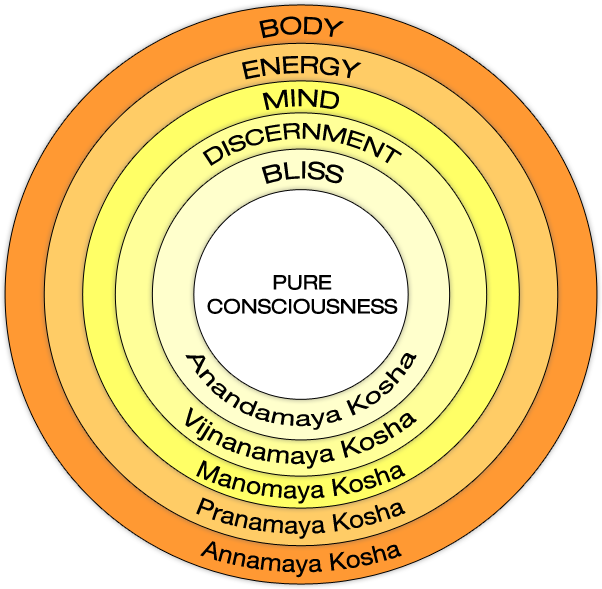
The five sheaths are:
1. Annamaya Kosha (food-sheath),
2. Pranamaya Kosha (vital sheath),
3. Manomaya Kosha (mental sheath),
4. Vijnanamaya Kosha (intellect-sheath)
5. and Anandamaya Kosha (blissful sheath).

'Maya' means full. 'Kosha' means sheath

Just as the scabbard hides the sword, the outer shell covers the tamarind fruit, the coat covers the body, so also these five sheaths hide the Atman. Hence the significant name Kosha. Just as the Kosakar worm gets itself bound in its nest, so also the Jiva gets himself bound within the Koshas.
  1. The Annamaya Kosha forms the gross body. 
  2. The Pranamaya, Manomaya, Vijnanamaya Koshas go to constitute the subtle or astral body or Linga Sarira. 
  3. The Anandamaya Kosha forms the causal body or Karana Sarira. 
The five Karma Indriyas (mouth or speech organ, hands or working organs, legs or locomotion organs, excretory organ and reproductory organ) are contained in the Pranamaya Kosha. The five Jnana Indriyas (eyes-see, ears-hear, tongue-taste, skin-touch and nose-smell) are contained in the Manomaya Kosha.

There is an illusory connection between the Koshas and Atman through Anyonya Adhyasa or mutual superimposition by which the Dharmas or attributes of the Koshas appear on the Atman and the Dharmas of the Atman on the Koshas.

It is the innate tendency of the human mind to identify the Self with the five Koshas. This is due to ignorance (Avidya) only. This is due to Adhyasa or superimposition. 

The ignorant man of dull intellect identifies the Self with the physical body. Others identify the Self or Atman with Prana, mind, intellect, or the Karana Sarira according to their various grades of intelligence.

Ignorance and non-discrimination

All this illusion has arisen in men on account of ignorance and non-discrimination or absence of the faculty which discriminates between the eternal Atman and the illusory five sheaths which are falsely superimposed upon the Atman. 

The five sheaths are creations by the mind on account of ignorance. The five sheaths cannot be the pure, self-existent, self-luminous Atman. Srutis emphatically declare that the Atman is bodiless. Just as the changes that take place in the cow such as growth, decay, etc., do not in the least affect the proprietor of the cow, the seer, so also the changes that occur in the five sheaths do not touch their proprietor and seer, the Atman.


Just as you can clearly distinguish the sound of one man from another through the power of discrimination; just as you can clearly feel, this is soft, this is hard, this is hot, this is cold, by the power of discrimination; just as you can clearly understand by looking at a picture on a wall, this is black colour, this is red colour, this is wall, this is a picture, through the power of discrimination, although you are not able to separate the red colour from the black colour, the picture from the wall; just as you can clearly understand by tasting a drink, this is lemonade, this is orange, this is raspberry, through the power of discrimination, although you cannot separate the salt or sugar from the water; just as you can know the odour in a cloth by the organ of smell although you cannot separate the odour from the cloth; so also you can clearly differentiate Atman and the Koshas by understanding the essential nature of Atman and the five sheaths, by hearing Vedanta from a Guru. You can clearly understand that there is no connection between the Atman and the five sheaths. 

Although it is impossible for ordinary people to separate water from milk, yet it is possible for a Hamsa (swan) to separate water from milk. Although it is impossible for people of gross intellect to differentiate Atman from the five sheaths, yet it is possible for a man of subtle intellect to differentiate between them.

The five sheaths are not really in Atman. Just as the snake is superimposed upon the rope, silver on the mother-of-pearl, thief on the post, water in the mirage, blueness in the sky, so also the five sheaths are superimposed on the Atman on account of ignorance. Just as the illusion of snake vanishes when the knowledge of rope is attained, so also the erroneous conception of the five sheaths disappears when one gets knowledge of the Self.

A detailed knowledge and comprehensive understanding of the five sheaths is an indispensable requisite, if you want to attain Self-realisation and practise the 'Neti-neti' doctrine of Vedanta.
NOTE:
A student who treads the path of Truth (especially the path of Jnana yoga y Vedanta) must first equip himself with Sadhana Chatushtaya - the "four means of salvation".

1. discrimination, (Viveka)
2. dispassion, (Vairagya)
3. the sixfold qualities of perfection, (Shad-Sampat )
4. and intense longing for liberation, (Mumukshutva)

Read also the related essays:

Read the book:
Moksha Gita(.pdf) : an exhaustive treatise of the highest wisdom of the Advaita Vedanta.
A study of Moksha Gita alone is enough to guide a sincere aspirant in the path of Jnana-Yoga.
By practicing its teachings one gets liberated from all bondage and becomes Immortal

Saturday, January 16, 2016

Superimposition and discrimination II by Swami Sivananda

    "The jiva (individual soul with ego ie. encarnated being) must dehypnotise himself by meditation on the significance of "Tat Tvam Asi" Mahavakya (" I am That"). Then alone he will be free and the Jiva who was bleating like a lamb will roar like a lion."

Adhyasa or Superimposition
by Swami Sivananda   

MAN'S transmigration is due to the evil of superimposition and the bondage of superimposition is created by himself and none else. It is this that causes the misery of birth and death for the man of non-discrimination who is tainted by Rajas and Tamas. Superimposition is the favourite theme of the Vedanta philosophy to explain how the ever-free Self came to be bound at all. The Jiva is under self-hypnotism. He must dehypnotise himself by meditation on the significance of "Tat Tvam Asi" Mahavakya (" I am That"). Then alone he will be free and the Jiva who was bleating like a lamb will roar like a lion.

Adhyasa literally means 'superimposition' in the sense of mistaken ascription or imputation to something of an essential nature or attribute not belonging to it. It is an apparent presentation of the attributes of one thing in another thing. It is the illusory attribution or superimposition of the universe in the Atman which has no universe in it, like the misconception of silver in mother-of-pearl, snake in the rope, man in the post, bluishness in the sky, water in the mirage. This wrong notion is caused through Avidya or ignorance.

It is a serious mistake to superimpose on the subject, (i.e., Atman) whose nature is Intelligence, the object (ie., body sense, mind etc.) whose nature is insentiency and vice-versa to superimpose the subject and the attributes of the subject on the object. The subject is Atman or the Supreme Self whose nature is absolute consciousness. The object includes whatever of a non-intelligent nature, viz., body sense, mind, Prana and the objects of the senses, i.e., the manifested phenomenal universe.

If the Atman or Brahman is really unconnected or unattached (Asanga), how can He be so related to the Koshas (sheaths) or the bodies as to be ordinarily regarded one with them?
The relation of Atman with the bodies can be only Adhyasa (superimposition) like that of a snake in the rope. This Adhyasa is of two kinds: One-sided and mutual
One-sided is in the case of rope which appears to us as snake; the snake is superimposed on the rope but not the rope on the snake.
Mutual (Anyonya Adhyasa) in the case of Atman with the bodies or koshas: The Atman and its attributes are superimposed on the Koshas and the Koshas and their attributes are superimposed on the Atman. So we say, My body exists, shines and is blissful and I am a man, I am a Brahmin, I am a doctor, I am a celibate, I am a house-holder, I am hungry, I am thirsty, I am angry, etc.

Attributes of the body are superimposed on the Self, if a man thinks of himself (his self) as stout, lean, fair, as standing, walking or jumping; attributes of the sense organs if he thinks of himself as mute, deaf, one-eyed or blind; attributes of the internal organ (ie. mind, intellect, chitta) when he considers himself subject to desire, intention, doubt, determination and so on. Thus the producer of the notion of the ego i.e., the internal organ is superimposed in the inner Self (Atman), which, in reality, is the witness of all the modifications of the internal organ and vice versa, the inner self which is the witness of everything is superimposed on the internal organ, the senses, and so on. In this way there goes on this natural beginningless and endless superimposition, which appears in the form of wrong conception is the cause of individual souls appearing as agents and enjoyers (of the results of their actions) and is observed by everyone.

If nothing exists but one absolute simple Being (Brahman, Atman, Consciousness), if truth is one, whence arises this many which we experience through the Indriyas (senses), whence this appearance of this world by which we see ourselves surrounded and in which we exist as individual beings? Truth cannot certainly contradict experience. Brahman or Truth is associated with certain illusory power called Maya or Avidya to which this appearance of the phenomenal universe is due.
This is the statement of Sankaracharya. This world is not real. This plurality is an illusion. It is mere appearance like snake in the rope. It vanishes when one gets the knowledge of the Self. Avidya is beginningless but it terminates in the aspirant when Brahma Jnana dawns. So Avidya is beginningless and terminable (Anadi-santam), viz. terminates after the attainment of Brahma-Jnana.
This illusory power (Maya) cannot be called 'Being' (Sat) for 'Being' is only Brahman; nor can it be called 'Non-being' (Asat) in the strict sense, for it somehow produces the appearance of this world. Just as a magician produces many things, such a mango tree from a seed, money and sweetmeats from sand, so also Brahman projects the appearance of the sense-universe by means of the illusory power, Maya.
The individual soul blindly identifies himself with the adjuncts or vehicles (Upadhis, viz., the 5 koshas: the body, Prana, mind, Buddhi, causal body), the fictitious offering of Avidya. Instead of recognising himself to be pure Brahman, he calls himself a man (Jiva). The Avidya acts as a veil and hides his true nature (Atman). He is unable to look through and beyond the veil (Avidya). The body, senses, mind, etc., are superimposed on the pure Self (Atman) on account of the force of ignorance. Through the identification with the body, mind and senses, he imagines that he is the doer and enjoyer. The soul which in reality is pure all-pervading intelligence, non-active and infinite, thus becomes limited in extent as it were, limited in knowledge and power. Through his actions with selfish-motives, he burdens himself with merit and demerit. He has to reap the fruits of actions in future births. Thus he is bound down to this world. He is caught up in the round of births and deaths (Samsara). He has to enjoy happiness and misery.

Sankaracharya does not mean that the world is absolutely nothing like the horn of a hare, or a barren woman's son, or a lotus in the sky. He means that the world has a relative existence, i.e., it is not so real as Brahman who exists in the past, present and future, that it is not real at all times. When compared with Brahman, world is unreal. This is what he exactly means.
Maya cannot be adequately described. It is a mystery beyond our understanding. It is inscrutable or indefinable (Anirvachaniya). Brahman is not affected a bit by the illusion, just as a juggler is not affected by the illusion he produces. Just as a writer of a drama projects his own thoughts when he writes down the scenes in various acts, so also Brahman has projected this universe by mere willing. This theory or doctrine of Sankaracharya is known as Vivarta Vada or Maya Vada or Anirvachaniya Khyati Vada. A tree or dog or rose is a Vivarta or apparent modification of Brahman, just as earring or bracelet is a Vivarta or apparent modification of gold.

The aim of Vedantic Sadhana is to destroy entirely the erroneous idea, 'I am the body' and to substitute the idea, 'I am Brahman.' When you get knowledge of the Self (Atman, Consciousness), this erroneous idea, 'I am the body' is annihilated and you get liberation or Mukti. This mistaken idea is removed automatically, just as the illusory snake which is superimposed on the rope is destroyed by bringing a light; so also the idea of reality of this world is removed, when you get knowledge of Brahman. The Srutis emphatically declare: 'Rite Jnananna Mukti - there is no liberation without knowledge of the Self.' 'The heart's knot is broken; all doubts are cleared, all Karmas are burnt when one realises the Self.' by knowing the Self, one passes beyond death; there is no other way.'

The superimposition is destroyed by knowledge of the Self. This knowledge of the Self is not mere theoretical or intellectual knowledge. It is actual realisation through constant meditation. It is direct intuitional knowledge gained by coming in direct contact with Brahman.

Avidya is nescience or ignorance. Superimposition is Avidya. Avidya or false knowledge is destroyed when true knowledge of the Self dawns. Avidya does not mean want of knowledge. The ascertainment of the true nature of the Self by means of discrimination of that which is superimposition on the Self is known as Vidya.

This relation of superimposition is not recognised in the higher teachings of the Vedanta, because superimposition connotes the existence of two distinct subjects at the same time. But the rope is not perceived when the snake is cognised and the snake is not perceived when the rope is cognised. There is no existence of two objects at the same time to enable one object to be superimposed upon the other. The rope alone exists before, during and after its apparent appearance. Similarly the Koshas do not really exist. They are illusory. Brahman alone exists. Brahman alone is the solid reality. The Koshas are apparently related to Atman.

Atman is without any kind of limiting adjuncts. It is bodiless. The mutual superimposition is due to ignorance or lack of discrimination.
This will vanish, if you comprehend the right significance of the Mahavakya and practise regular meditation. Just as the house is different from you, so also this body is different from you (the real you the Atman). An objector may argue: The chair is outside us while the Koshas are within us. This does not make any difference at all. A very sharp intellect is necessary to understand that Atman is distinct from the Koshas. In Kathopanishad, you will find: This Atman is hidden in all beings. It does not shine; but it is cognised by the seers who possess subtle sharp intellect.

The force of impressions is tremendous. Unless all the impressions are thoroughly burnt through entry into the state of the pure Nirvikalpa Samadhi, it is not safe for one to stay a long time in one’s native place. He will still be in the danger zone.

When Brahman is realised by means of Nirvikalpa Samadhi, then the heart’s knot viz., Avidya (ignorance), Kama (desire) and Karma (action), is destroyed.
~ Swami Sivananda


LIBERATION (Moksha) By Swami Sivananda 

Tuesday, January 12, 2016

Superimposition and discrimination of Atman from the 3 bodies by Swami Krishnananda

Superimposition and discrimination between Atman and the 3 bodies 
or five koshas

extract of the book "The Philosophy of Life" Ch.10: The Jiva
by Swami Krishnananda


The five sheaths (koshas) are comprised in the three bodies. The Atman is different from the sheaths the latter being external to consciousness (Atman). Their existence and intelligence are borrowed from Atman which is infinite existence and intelligence. Just as clouds which are generated by the rays of the sun, and which exist on account of the sun, cover the sun itself; just as smoke which draws its existence from fire conceals fire itself; so do the five sheaths, which owe their existence to the Atman, hide it from experience. It is the natural tendency of the mind to identify itself with the sheaths, and vice versa. This superimposition is mutual, and is caused by Avidya (ignorance). One has to realise one’s distinction from the five sheaths by the practice of the method of ‘Neti, Neti’, declared in the Vedanta.

The ignorant man identifies himself with the mass of flesh, fat, skin, bones, etc., while a discerning person becomes aware that he is an intelligent principle (Atman). The Pandit (Priest, Hindu scholar learned in Sanskrit and Hindu philosophy and religion, typically also a practising priest) who has only a theoretical knowledge identifies himself with a mixture of body, mind and soul, while the liberated sage (Jivanmukta) regards the eternal consciousness (Atman) as his Self.

There cannot be the relation of inherence between the sheaths and the Atman, for the insentient and the ephemeral cannot be said to inhere in the sentient and the eternal. There cannot be a relation between entities possessing entirely dissimilar properties. There is not, again, between the sheaths and the Atman, any external contact, for the Atman is unlimited, while the sheaths are confined to spatial and temporal endurance. The two are not made of the same substance, and so there cannot be any contact between them. The apparent relation between the Atman and the sheaths is one of Adhyasa or erroneous imposition (Superimposition).

Superimposition can be of two kinds: partial and mutual. When we see a snake in a rope, the snake is superimposed on the rope, but there is no superimposition of the rope on the snake. This is an instance where the error is one-sided or partial.
But the transference of attributes between the Atman and the sheaths is not thus overbalanced, but obtains on both sides; the superimposition is mutual. The essences of the Atman are projected on the sheaths and the defects of the sheaths are swung upon the Atman. This reciprocal superimposition is called Anyonya-Adhyasa. The nature of Satchidananda which belongs to the Atman is falsely attributed to the sheaths when one makes such statements as ‘My body exists,’ ‘my body is intelligent,’ ‘my body is dear,’ ‘my life is precious,’ etc. In statements like ‘I am a man,’ ‘I am a male,’ ‘I live,’ ‘I grow,’ ‘I die,’ ‘I am hungry,’ ‘I am thirsty,’ ‘I am happy,’ ‘I am sorry,’ etc., there is seen an interjection of the qualities of the sheaths on the Atman. It is this apparent relation that is brought about between the Atman and the sheaths that is the cause of one’s bondage and suffering, and it is the aim of the Vedanta to enlighten the Jiva in its attempts to overcome this ignorance and to realise the Atman in this very life.

The five sheaths (five koshas) have no independent reality from Atman (Consciousness). Just as the mutations that take place in the body of a cow,—growth, decay, etc., do not in the least affect the owner of the cow, who is only a witness, so the changes that occur in the sheaths do not touch the Atman which is their witness.
Just as one can distinguish the sound of one person from that of another through the power of discrimination; just as by this faculty one can feel: ‘This is soft, this is hard, this is hot, this is cold,’ etc.; just as one can, by looking at a mural picture on a wall, say: ‘This is blue colour, this is red colour, this is the wall,’ etc., with one’s discerning capacity, although one is not able to separate the red colour from the blue, or the picture from the wall; just as one can know by tasting a drink: ‘This is lemonade, this is orange,’ etc., through the understanding faculty; just as one can know the odour in a cloth by the organ of smell, although the odour cannot really be separated from the cloth; so also one can clearly differentiate the Atman from the sheaths by an analysis and study of their respective natures.

It is impossible for ordinary people to separate water from milk when the two are mixed together, but it is possible for a swan to do so.

In like manner, though it is impossible for persons of gross understanding to distinguish between the Atman and the sheaths, yet, it is within the capacity of an aspirant endowed with subtle discrimination to fulfil this difficult task.

A pure sattvic buddhi can have the capacity of subtle discrimination and this is the result of a long time systematic sadhana. Dsicrimination (VIveka) together with vairagya (dispassion) are the most important qualifications for self-realization.  ~ Atman Nityananda

READ MORE ABOUT THE  DISCRIMINATION - ATMAN - FIVE KOSHAS


SOURCE http://www.swami-krishnananda.org/phil/phil_10.html