The three main objectives self-inquiry
The three objectives we use self-enquiry is discerning our divine essence from apparent or lower self, investigate the psychological issues and tendencies and maintain conscious contact with our divine essence (the silent space of consciousness within) and be established in it.
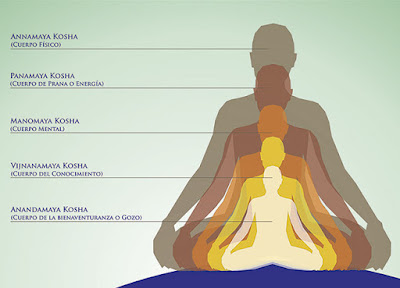
- To Discern our Divine Essence from the layers or 5 sheaths.
- To inquire into the Psychological structures and tendencies.
- To Establish our attention in our True Self, that is, in the silent space of Consciousness.
The 5 Sheaths: According the Advaita Vedanta our apparent self is constituted by five Sheaths.
The five sheaths are:
1. Annamaya Kosha (food-sheath),
2. Pranamaya Kosha (vital sheath),
3. Manomaya Kosha (mental sheath),
4. Vijnanamaya Kosha (intellect-sheath)
5. Anandamaya Kosha (blissful sheath).
‘Maya’ means full. ‘Kosha’ means sheath
You can read about the 5 Sheaths in the following text of Swami Sivananda: Discrimination between the Self and the non-self by S. Sivananda
You van also read the book Vivekachudani: Adisankarcharya Vivekachudamani.pdf
A brief analysis of the different types of self-inquiry
Discerning our Divine Essence from the layers or 5 sheaths
Explore our divine essence beyond the body, energy, mind, intellect, and ego. Self-inquiry reveals the true Self within.
This type of inquiry is based on the teachings of great masters and spiritual traditions that help us to investigate our immediate experience. Based on the knowledge we explore one by one the layers of our apparent existence.
The purpose of this inquiry is to realize that we are not them and to discern our immortal divine essence (Consciousness) from all the layers.
Inquiring into the Psychological structures and tendencies
Dive deep into your psyche. Self-inquiry unveils the layers of your mind, helping you understand, overcome and eliminate egoic tendencies, emotional and mental patterns, false beliefs and overcome psychological issues.
We dedicate time every day at our place to investigate and delve into the issues and psychological reactions and tendencies we have observed during the day manifest in us.
This process allows us to realize their mechanical repetitive nature, their illusory quality, their causes, and consequences. Through this process we realize that we are not these emotional and mental reactions and we become able to stop identifying with them.
Finally, we use certain means, such as prayer, mantras and EFT, to dissolve part of their energy and weaken them as much as possible for the time being.
Short and Long prayer for the dissolution of Ego
However, it is highly recommended this aspect of self-enquiry to be used throughout the day whenever it is necessary to avoid or cease identification with sensory reality or mental and emotional reactions and make them subside.
Establishing our awareness (attention) in the silence space of Consciousness
The self-inquiry is perhaps the most powerful means to cease identifying with psychological expressions and sensory impressions and anchor our attention in the silent space of consciousness.
This type of Self-inquiry is a process by which we withdraw our attention from any objective experience and focus it on the silent space of Consciousness within ourselves. To facilitate this process we use some question or questions such as, “To whom do these thoughts arise?”, or “To whom does this emotion or impulse arise?”, or “To whom does this perception arise?”. The answer is, “To me.” And then we ask: “Who am I?”, or “What am I?”, or also, “What is the source of the Me or I?”.
This aspect of self-enquiry is practiced in both cases, as a seated meditation and as a means of remaining in self-awareness and detached witnesses of the inner and outer world moment by moment throughout the day.
However, this practice can be successfully practiced as the main or only method of practice by mature aspirants who have developed a pure sattvic mind that involves the development of important sattvic qualities or skills such as devotion, self-awareness, detachment, discernment, dispassion, clarity, one-pointedness of mind and steadiness of mind.
Less mature aspirants should follow a more comprehensive practice that will include a variety of practices related to all aspects of our existence aimed at the purification of the mind and heart and vital energy, the elimination of egoic tendencies of all kinds, and the development of the sattvic qualities of mind and heart.
This is the most direct way or method to focus and stabilize our awareness on our essential divine nature and finally establish ourselves in it.
You can read about the practice of Self-enquiry, The Practice of Self-Enquiry Enquiring ‘Who Am I?’ -Ramana Maharshi
The ‘secret’ to a plentiful life, a life of harmony, happiness and contentment is to have a sattvic mind free from desires and ego and to live in every moment in conscious contact with our true Self (Consciousness).
🌺 Peace, Love, Harmony